



On national radio recently, a Christian commentator was asked about the calls to make this country Christian again, and this was his answer:
“I am a Christian who studied theology, and Jesus wasn’t a Christian. He was a Jew. Jesus welcomed people of all religions and races. In fact, it upset the religious leaders. Those were the only people Jesus was ever angry with — the excluders. Jesus didn’t care about people based on their religion or their colour. Jesus welcomed everyone. So, therefore, to be a Christian nation is to be an inclusive nation.”
The argument feels compassionate, generous, and obviously Christian, and it appeals to something deep in us. None of us wants a narrow church, or a fearful one, or a church that turns people away from Christ. Yet as I listened, I found myself wanting to ask the one question nobody in the studio seemed interested in asking.
Inclusive of what?
The question is never whether inclusion is good; the question is always inclusion into what. Inclusion is not a destination but a direction. It tells us that a door is open, but it says nothing about what lies beyond. The Christian story has always insisted that the door is open, so the real question has never been whether people are welcome. The question has always been what they are being welcomed into.
Who This is For

A brief word before I go on. I am not writing against the people who built forms of the ‘inclusive’ church. Many of them arrived where they are through compassion: through knowing people who had been wounded by the church and wanting to ensure they were not wounded again. That impulse is not the problem. It is one of the most Christian instincts there is.
When people hear the language of repentance, they often hear rejection; when they hear the language of transformation, they hear condemnation; when they hear the language of holiness, they hear exclusion. I understand why, because the church has too often taught exactly those lessons. Yet the answer to distorted transformation cannot be the abandonment of transformation altogether. The abuse of a thing does not remove the need for the thing itself.
What concerns me is something else: the framework that gradually formed around that compassion, and what it has quietly done to the faith. I am writing for those who feel uneasy. Those who sense that something has gone wrong and struggle to put it into words. Those who have begun to wonder whether faithfulness and cruelty have somehow become confused with one another. Those who suspect that their discomfort must mean they lack compassion.
It does not.
This short essay is an attempt to give that unease some language.
A Word That Carries Too Much Weight

And the words the church once used tell us what is missing. Koinonia. Agape. Philoxenia. Caritas. Communio. Each carried its own theological grammar. Koinonia meant participation in Christ; you could not have it without participation. Philoxenia meant receiving the stranger as Christ; you could not have it without receiving Christ. Inclusion has no such grammar of its own. It borrows whatever grammar surrounds it — corporate diversity, therapeutic affirmation, liberal politics, the language of rights. The word is empty by design. That is why it can be poured into any vessel and made to sanctify it.
Inclusion has no such grammar of its own.
It borrows whatever grammar surrounds it, be that corporate diversity, therapeutic affirmation, liberal politics, or the language of rights. The word is empty by design. That is why it can be poured into any vessel and made to sanctify it.
The argument works like this. First, assert that Jesus was inclusive, which is true, as far as it goes. Second, define inclusion by listing the specific things you include. Third, conclude that anyone who doesn’t include those same things is therefore exclusive and un-Christian.
But step two is doing all the work, and is often unexamined. The speaker gets to define inclusion, and then uses that definition to exclude. It is the oldest linguistic move in progressive rhetoric: seize a universal term, then fill it with particular content, and wield it against anyone who objects. Diversity. Equality. Now inclusion. The words arrive trailing virtue, to make disagreement look like bigotry before it has been given a hearing. This is not an argument.
It is a vocabulary coup.
For much of Christian history, inclusion sat alongside other Christian goods such as holiness, truth, charity, worship, repentance, communion, mission, discipleship, and none of them stood alone. Each was held in relationship with the others.
Increasingly, inclusion has become more than a virtue. It has become the lens through which everything else is read: Scripture, doctrine, ethics, and the church itself. The danger is not that inclusion matters too much, but that it comes to matter more than everything else.
But the move goes further than a single word. It now operates on the noun itself. Inclusive church. Emerging church. Progressive church. Affirming church. Open church. In each case, the qualifier sits in front of the noun and silently reorders what the noun used to mean. The adjective was supposed to describe a kind of church. It now claims to be the true form, from which everything else is a deviation.
The ancient creeds knew the four marks of the church: one, holy, catholic, apostolic. Each was inseparable from the others. New qualifier-church descriptors drop three in order to absolutise the fourth, or import a fifth and rank it above the original four. The Catholic Church is a confession of unity across time. Inclusive Church elevates one chosen virtue to become the organising principle of the whole.
This is not a renewal movement. Renewal works through the whole. The monastics renewed the church through prayer. The Reformers renewed it through the recovery of grace. The charismatic renewal restored attention to the Spirit. Each contributed to the totality of the gospel. The ‘qualifier-churches’ do something different. They lift one virtue out of the whole and announce that the whole must be reordered around it. The qualifier no longer describes. It governs.
A New Creed and Confession
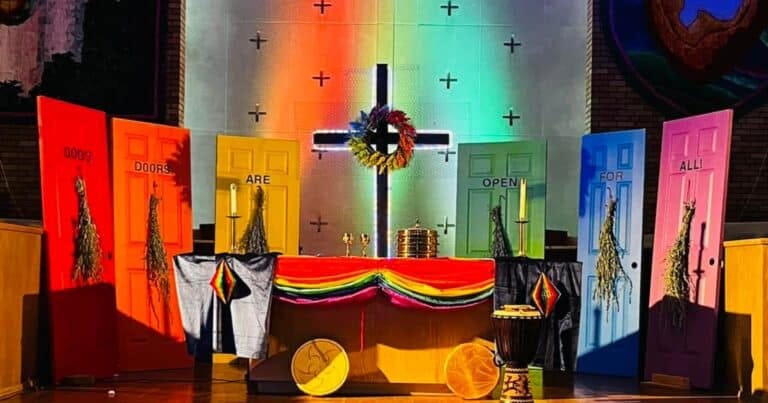
Inclusion rarely arrives alone. It comes as a "package deal" of identity politics that bundles a person’s faith with a specific, non-negotiable set of modern left-of-centre political and social positions. To be considered an authentic “Christian,” you are often expected to buy into the entire package. Which most often includes affirmation of every sexual and gender identity; diversity, equity, and inclusion as an ordering principle; decolonisation; pro-Palestinianism and climate activism; pro-choice; the vocabulary of allyship and lived experience.
You can predict the whole package from any one of its parts. A Christian and a church that adopts one will, within a few years, have likely adopted them all. This is not a coincidence. It is coherence. The parts hold together because something underneath holds them together. And what holds them together is a complete account of reality.
It has its own story of what is wrong with the world: hierarchy, exclusion, the inherited sins of the West. Its own account of who is good: the marginalised, defined ever more finely. Its own salvation: liberation, visibility, validation, the dismantling of structures. Its own righteousness: allyship, deconstruction, the confession of one’s privilege. Its own damnation: to be found on the wrong side of history, named a bigot, and cast out.
This is not merely a set of opinions. It is a soteriology and means of salvation. It tells you what is broken, who is righteous, what must be done for salvation and what awaits those who refuse. Belonging now comes to be measured by this new confession. One way to diagnose what confession is at work is to ask, could someone who does not believe in Christ say these sentences from two confessions?
Love is love. Yes. Trans rights are human rights. Yes. We stand with the marginalised. Yes.
I believe in one God, the Father almighty. No. He was crucified under Pontius Pilate and rose again on the third day. No. I am dead to sin and alive to God in Christ Jesus. No.
The first confession can be spoken by anyone. The second can only be spoken by someone who has staked their life on a crucified and risen Lord. When a church says the first fluently and the second only with embarrassment or complete elision, a substitution is complete.
Most Inclusive Christians did not set out to replace the gospel with an identity politics programme. They set out to love people the church had failed to love, and they reached for the only moral vocabulary the surrounding culture still offered with confidence. The vacuum was real, as was the compassion. What began as a way of loving the excluded becomes, in time, the thing by which the church defines itself — and a church defined by the new creed and confession no longer needs the old one. Christ becomes optional and a figure invoked to bless pre-existing commitments that the church could hold just as firmly without him.
The Door Jesus Actually Opened
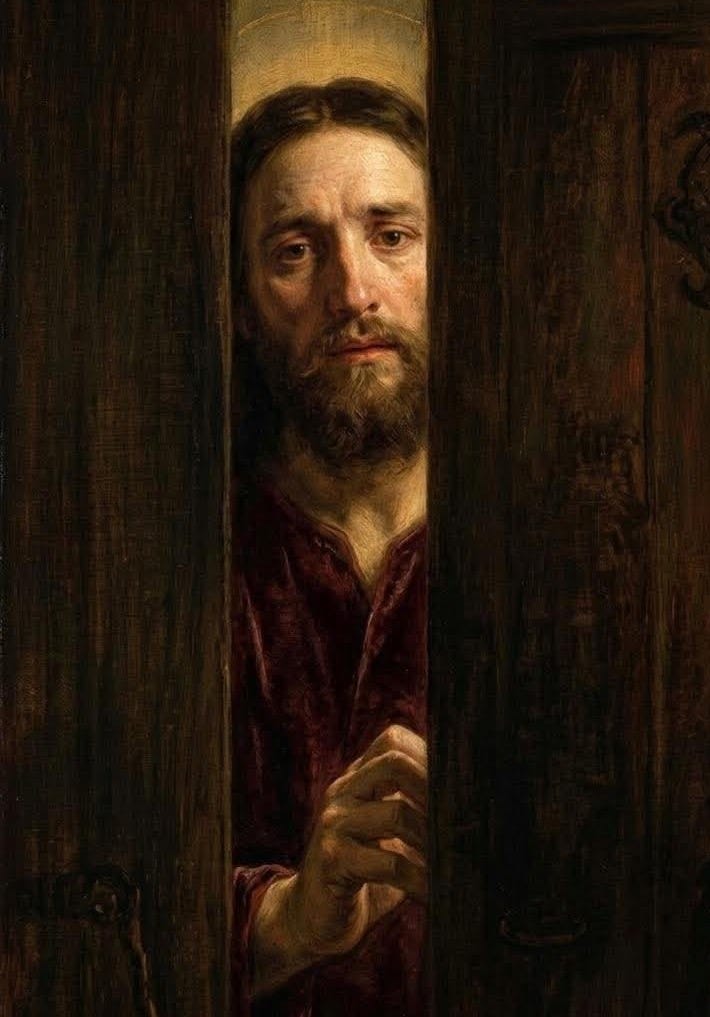
There is a version of Jesus that fits comfortably within modern assumptions. In this version, he walks through Galilee, affirming people exactly as they already understand themselves. His primary concern is that nobody feels excluded, and his chief opponents are those who would challenge another person’s identity or self-understanding. It is an appealing picture, and it is also very difficult to reconcile with the Gospels.
The Jesus of the Gospels does something stranger and far more generous. He invites everyone into a kingdom that begins with repentance - metanoia: the turning of the whole person. Not self-improvement. Not therapy. Not the affirmation of the self you have already built. But a re-making.
The first word of his public ministry is not affirmation, but repentance, and repentance has become one of the most misunderstood words in Christianity. It is usually heard as self-loathing or moral self-improvement, when in reality it means something far deeper. It means turning toward reality. It means reorienting one’s entire life toward God. Repentance is not the rejection of the self; it is the surrender of the illusion that the self can be its own source and centre.
This is why Jesus can offer unconditional welcome and radical transformation in the same breath, because the two belong together. He does not love people because they have changed, nor does he love them so that they can remain unchanged. He loves them into change.
This is the most radical welcome imaginable. Because it means Jesus meets you precisely as the person who needs re-making, which is all of us. The tax collector, the Pharisee, and the woman caught in adultery. The door through which everyone enters is the same: the recognition that who I have made myself to be is not the whole story of who I am.
This fragmentary Jesus of ‘inclusive christianity’ is manufactured the same way every time. The only people Jesus was ever angry with were the excluders. But Jesus was angry at many things. Hypocrisy. Greed. Hard-heartedness. Religious performance. Unbelief. The misuse of Scripture to evade duty. He pronounced woes on whole cities. He spoke of outer darkness, of the narrow gate, of depart from me, I never knew you. The inclusive Jesus is not a discovery. He is a self-selected fragment of the Gospels, polished and held up as the whole.
Affirmation vs Transformation

As mentioned already, inclusion is not a virtue until you specify what you are including people into. The church is not primarily a space of affirmation; it is a community of transformation. It includes sinners — all of us — not to leave us as we are, but because what we are is not yet what we shall be.
The Christian claim is not that you are fine as you are. The Christian claim is that you are loved as you are, and that the love is powerful enough to change you. Come as you are. You will not stay as you are. Both of those things are true. Both of those things are good news. To call that exclusive is to have misunderstood the gospel. Or to have understood it and decided to prefer something else.
From its inception, and for two thousand years, the gospel has been the offer of inclusion in Christ. Our inclusion isn't a project of self-creation, but a surrender to the cross, where we drop the exhausting act of defining ourselves and instead receive our true identity by actively participating in the death, resurrection, and self-giving love of Jesus Christ.
This participation is the deepest freedom a human being can know. The exhausting labour of self-authorship is over. You no longer have to hold yourself in being. You no longer have to justify your existence with your achievements, your alignments, your correct positions, the endless maintenance of a self that was never firm enough to stand on. You are held. And the self you receive, hidden now with Christ in God, is not smaller than the one you were building. It is the one you were always meant to be, the one your self-creations were a forgery of.
Freedom is not the freedom to do as you please. It is the far greater freedom of no longer needing to secure yourself at all. This is what the inclusive door opens onto. A cross, an empty tomb, and a life poured out that you could never have authored yourself. That is the inclusion the gospel offers.
Affirmation leaves you exactly as you are. The gospel makes you large enough to die for someone else.
“Those who suspect that their discomfort must mean they lack compassion.
It does not.
This short essay is an attempt to give that unease some language.”
Thank you for writing this. For several years I have been wrestling with this uneasiness without the words to fully describe it. I’ll be spending time with your essay over the coming weeks to more fully consider the arguments you make.
"Jesus loves them into change."
"The Christian claim is not that you are fine as you are. The Christian claim is that you are loved as you are, and that the love is powerful enough to change you. Come as you are. You will not stay as you are. Both of those things are true. Both of those things are good news."
I'm thinking out loud here... I wonder if people long for affirmation - even from church - because our society is already so full of judgment. From the advertising industry to partisan politics to the difficulty getting employment, people don't feel like they are "enough" so when someone tells them they're fine as they are, that's really attractive.
And you and I both know that most people are really NOT aware of their inner world. "That's just the way I am" we hear; they have no desire to change. They usually think their problems are everyone else's fault. Or, they just don't even have the time or energy bandwidth to think about it at all.
The really attractive invitation from God - by the Spirit, through the Church - is exactly what you wrote at the end. That's the gospel, the good news. People just aren't hearing it. Are we not properly saying it or sharing it?
"From its inception, and for two thousand years, the gospel has been the offer of inclusion in Christ. Our inclusion isn't a project of self-creation, but a surrender to the cross, where we drop the exhausting act of defining ourselves and instead receive our true identity by actively participating in the death, resurrection, and self-giving love of Jesus Christ.
"This participation is the deepest freedom a human being can know. The exhausting labour of self-authorship is over. You no longer have to hold yourself in being. You no longer have to justify your existence with your achievements, your alignments, your correct positions, the endless maintenance of a self that was never firm enough to stand on. You are held. And the self you receive, hidden now with Christ in God, is not smaller than the one you were building. It is the one you were always meant to be, the one your self-creations were a forgery of."