


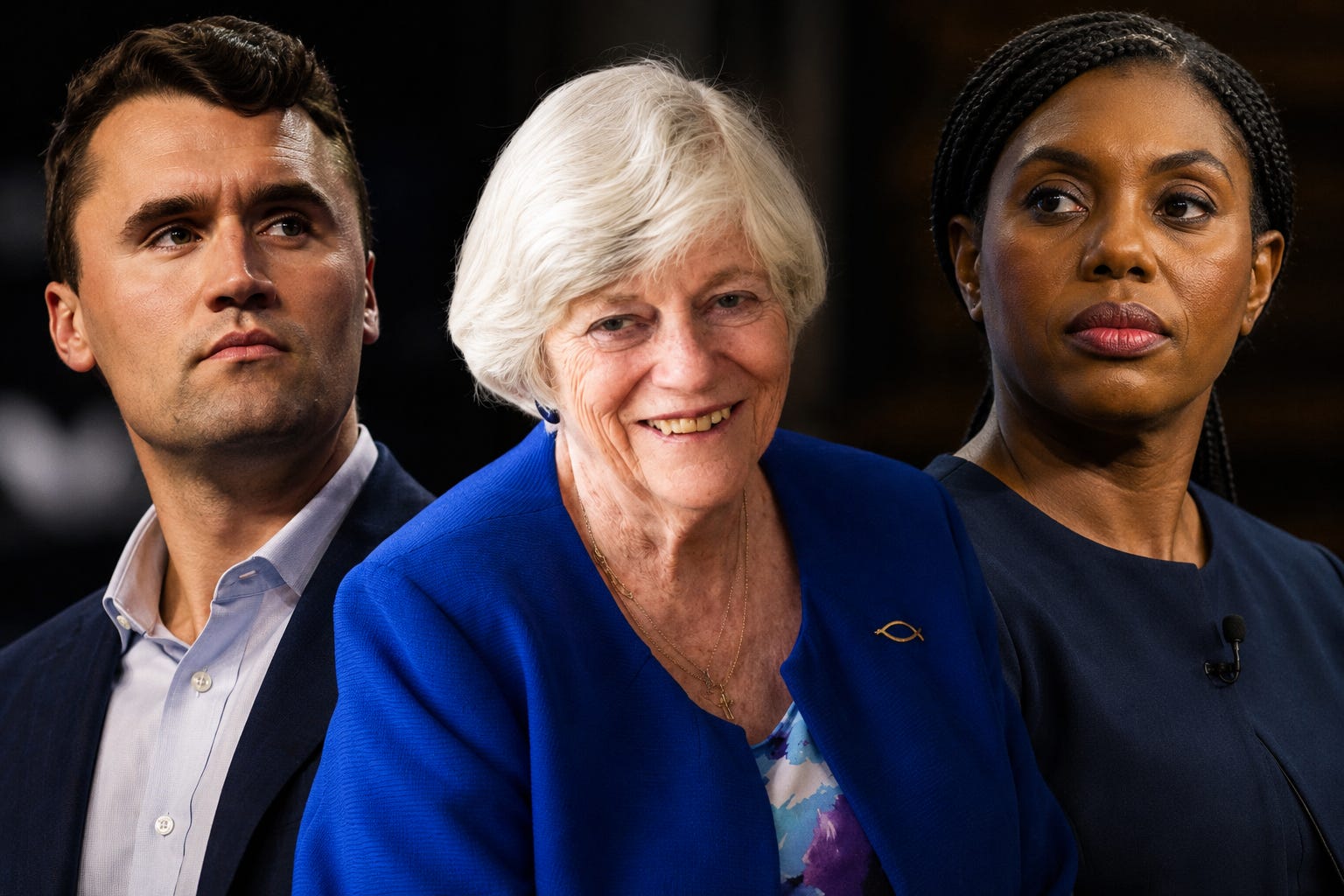
At the 2024 British LGBT Awards, David Tennant received an award for being a celebrity ally. During his acceptance speech, he turned his attention to Kemi Badenoch, then the Minister for Women and Equalities.
“Until we wake up and Kemi Badenoch doesn’t exist any more. I don’t wish ill of her, I just wish her to shut up.”
The audience applauded.
To be fair to Tennant, later qualified what he had said, no doubt aware of its implications and growing backlash. He did not claim that he wanted Badenoch harmed or killed. He appears to have meant that he wanted her removed from public influence and, more particularly, silenced.
Yet the qualification does not make the sentence less revealing. It clarifies the kind of non-existence being imagined. The preferred world is one in which the dissenting person has disappeared from public life and can no longer speak.
It would be a category error to pretend that a hostile comment about one politician is equivalent to wishing away an entire race, religion or sexual minority. It is not. Yet we know instinctively why the language of non-existence is so dangerous. Replace Badenoch’s name with the name of a class of people defined by their race, religion or sexuality, and the obscenity becomes immediately apparent.
Naming a single political opponent does not make the desire to erase harmless. It merely makes it easier for an audience to applaud.
The question that interests me is not whether David Tennant is a good or bad person. Nor is this principally an argument about his politics, Badenoch’s politics or the contested questions of sex and gender that lay behind his remark.
The more searching question I want to explore with you is this:
What kind of identity requires the silence, disappearance or non-existence of another person in order to feel secure?
Why Fragile Identities Crave Affirmation

All human identity is formed through relationships. None of us creates ourselves from nothing. We learn who we are through families, communities, languages, traditions, bodies and histories. We need recognition from others because we are social creatures.
There is nothing pathological about wanting to be known, respected or treated with dignity.
The difficulty begins when the self claims absolute authority to create its own identity while also requiring everyone else to ratify what it has created. It says, in effect, “My identity is mine alone to define, but it cannot remain secure unless you repeat my definition of myself.”
That places an impossible burden and requirement upon everyone else.
Their disagreement can no longer be received as disagreement. It is experienced as a refusal of my existence. Their words are not merely mistaken or offensive. They become an assault upon my being.
Once disagreement has been translated into existential harm, the dissenter becomes dangerous. If their speech becomes a threat to my existence, even their silent beliefs start to feel like a negation of myself. If their presence destabilises my identity, their disappearance can begin to feel like liberation.
This pattern is not confined to a single political movement or to one side of the argument about sex and gender. Religious, nationalist, racial and political identities can all become organised around the same fragility. Ideologies change, but the structure of human behaviour remains remarkably consistent.
I do not merely believe that you are wrong. I need you to affirm me.
I do not merely want to persuade you. I need to compel you.
I do not merely oppose what you believe. I begin to imagine a better world in which people like you can no longer speak.
Eventually, the imagined better world becomes one in which you are no longer present at all.
This is what I mean by ontological fragility. Ontology is simply the language we use when asking what it means to exist, what is real and where our being comes from. An ontologically secure identity can survive the existence of people who reject it. An ontologically fragile identity cannot. It must keep recruiting witnesses, demanding recognition and silencing contradiction because the self it has created lacks sufficient substance to stand without continuous public confirmation.
The problem is not simply intolerance. It is a self that has become dependent upon the negation of another.
Dancing on Graves: What death permits us to say

The recent murder of Ann Widdecombe has brought this into sharp focus again.
Widdecombe was found dead at her home in Devon on 9 July 2026 with serious injuries. Police opened a murder investigation, and Counter Terrorism Policing later assumed responsibility for the inquiry while officers continued to investigate the motive.
Her death was followed by a stream of online contempt. There were people who did not merely criticise her political record or express relief that she would no longer exercise influence. Some celebrated. Some appeared to take pleasure in the possibility that she had suffered. Police are actively investigating social-media posts celebrating her death.
The same pattern followed the assassination of Charlie Kirk at Utah Valley University in September 2025. Many people across the political spectrum condemned his murder. Others joked about it, rationalised it or celebrated it. A Reuters examination found posts declaring that he had received what he deserved, alongside others invoking the language of karma.
People’s mileage with social media will vary. Yet anyone who doubts that this attitude exists can spend a few minutes searching the names of Ann Widdecombe or Charlie Kirk on the major platforms. You do not need to scroll far before encountering people who regard death as a legitimate verdict upon an opponent’s beliefs.
The argument frequently takes the same form.
This person held beliefs that caused harm. Their words made other people feel threatened, unsafe or denied. Their death is therefore interpreted as a form of recompense. The suffering of the deceased restores a supposed moral balance because they are believed to have caused existential suffering in others.
This is the point at which a political disagreement becomes a metaphysical drama. The deceased is made to carry responsibility for the pain, insecurity and instability of those who hated them. Their death is then treated as though it has removed something poisonous from the universe.
It has not.
No human death can bear that redemptive burden.
Relief is not the same as delight

An important distinction needs to be made here.
Someone who has suffered serious physical, sexual or psychological abuse may experience relief when their abuser dies. That relief can be the body’s recognition that an actual threat has ended. The continued existence of an abuser can feel like the continued presence of the world in which the abuse occurred. Their death may finally remove the possibility that they will return.
I know something of this distinction personally. My childhood and early adult life were marked by prolonged emotional and physical abuse from my mother, and later by persistent verbal abuse and manipulation from both my parents. When they eventually took their own lives—something I would never have wished upon them—I discovered, alongside the grief, an unexpected relief. When someone asked what it had been like, the word that came was quiet.
After years of noise, pressure and emotional intrusion, there was finally silence. I was not glad that they were dead; I was relieved that the abuse had ended. Their tragedy, as I came to understand it, was an inability to form selves stable enough to live without controlling, manipulating and wounding others. Their deaths did not satisfy me. They ended the demand that I keep carrying the instability of their identities.
It would be pastorally cruel to stand at a safe distance and lecture survivors about the emotions they should experience. Relief is not always vengeance. Sometimes it is the first sensation of safety.
Our legal traditions also recognise, however imperfectly, the human desire for a final reckoning with those who have committed terrible harm. Arguments about capital punishment partly turn upon whether the death of an offender can ever provide that finality, and whether the state has the right to provide it.
That is a serious and difficult moral territory.
It is also very different from taking pleasure in the suffering of a stranger because she defended traditional Christian beliefs about marriage, family and the human body, or because he expressed conservative political opinions that many found offensive.
Disagreement is not abuse. Offence is not violence. A public figure holding beliefs that contradict your own identity is not the same as an abuser retaining the power to enter your home, damage your body or control your life.
When these categories are collapsed, every political opponent, every person who disagrees with our beliefs can be redescribed as an abuser. Once that happens, punishment appears therapeutic. Cruelty can be presented as self-care. The suffering of the enemy becomes evidence that justice has occurred
The Grave Reveals the Living

Why does someone’s death so often become the moment when others finally say aloud what they have carried within them?
I suspect death removes the last restraints created by relationship.
While someone is alive, they can answer back. Their face, voice, family and vulnerability may disturb the caricature we have made of them. There may also be social, professional or legal consequences for publicly announcing that we wish they did not exist.
Death removes those restraints.
The dead cannot respond. They cannot correct our account of them. They cannot surprise us by displaying kindness, humour or vulnerability. They can be reduced entirely to a symbol of the beliefs we hated.
Death also gives malice a kind of moral camouflage. The speaker can claim not to be threatening anyone because the person is already dead. A desire that would have appeared vicious while its object was alive can now be disguised as commentary, satire, political analysis or moral judgement.
And now social media supplies the audience.
A remark that might once have remained an ugly private thought can now be turned into a public performance of allegiance. The cruelty proves that I belong to the right group. It shows that I know who deserves sympathy and who does not. Approval from the crowd converts malice into moral status.
The grave therefore becomes revelatory.
It reveals little about the dead that was not already known. But it now reveals the architecture of the living soul making its remarks about the dead.
The person celebrating imagines exposing their opponent's moral bankruptcy. In reality, they are showing how dependent their own identity has become upon opposition. Another person’s non-existence feels like an increase in their own being.
Yet being, identity, and self cannot be built by negation.
You do not become more substantial because another person has disappeared. You do not acquire dignity by celebrating the loss of theirs. You cannot heal your wounds by taking pleasure in someone else’s suffering.
Hatred creates nothing. It feeds upon what already exists. It promises strength while consuming the person who harbours it. It offers the temporary exhilaration of moral superiority, followed by the need for another enemy, another punishment and another public demonstration of contempt.
An identity that requires enemies will never run out of them.
The Identity Jesus Received

Christianity offers a radically different account of identity.
Jesus does not invent himself. His identity is received from the Father.
At his baptism, before he has preached a sermon, healed the sick or confronted an opponent, he hears that he is the beloved Son. His identity precedes his achievement. It is a gift before it becomes a vocation.
The temptations that follow are attempts to make him prove what he has already received.
“If you are the Son of God,” the tempter says, turn stones into bread. Throw yourself from the Temple. Demonstrate your power. Force reality to acknowledge who you are.
Jesus refuses.
The same temptation returns at the cross. If you are who you claim to be, save yourself. Come down. Make us believe. Establish your identity through spectacle, coercion and the defeat of your enemies.
Again, Jesus refuses.
The cross is where the received identity of Jesus is subjected to the complete refusal of others to affirm it. He is misnamed, stripped, beaten, mocked and displayed as a fraud. He experiences real violence, humiliation and abandonment. His enemies do not merely disagree with his beliefs. They attempt to destroy his body, erase his claims and extinguish his presence from the world.
Yet their refusal cannot alter who he is.
Jesus does not need his persecutors to validate his identity. He already knows himself as the one who comes from the Father and returns to the Father. His life is received rather than manufactured, and therefore it cannot be sustained or destroyed by the recognition of the crowd.
This allows him to do something that should still astonish us.
The one through whom all things were made, and in whom all things hold together, does not wish his enemies out of existence. The only person in the scene with the authority to summon overwhelming power refuses to use it to vindicate himself.
He forgives.
This is not because the abuse is unreal or the injustice trivial. Forgiveness is meaningful precisely because the wounds are real. Jesus does not pretend that crucifixion is a misunderstanding. He bears its marks in his risen body.
Yet he does not turn those wounds into a grievance around which to organise his identity.
When Jesus leaves the tomb, he does not establish a movement devoted to retelling the wickedness of those who harmed him. He does not gather his disciples to rehearse the humiliations he suffered or construct a programme of revenge against Rome, Pilate, Herod or the religious authorities.
Instead, He comes speaking peace.
He restores Peter. He breathes the Spirit. He sends his followers into the world. His wounds remain visible, but they are no longer weapons with which to control others.
The risen Christ is not without memory. He is without resentment.
What Happens When We Face Death?

This is the identity Christians are invited to receive.
Christian identity is not dependent upon everyone believing in Jesus. It does not cease to exist because someone mocks the Church, rejects the resurrection, disputes Christian sexual ethics or regards Christian belief as dangerous.
People are free to disagree with us. They are free to ridicule what we believe. They may misunderstand our motives, denigrate our faith and refuse every account we give of ourselves.
None of that can remove an identity received in Christ.
This does not require passivity. Christians may oppose falsehood, resist injustice, protect the vulnerable and argue forcefully in public. Love does not prevent judgement. It governs the purpose and manner of judgement.
The Christian does not need to coerce others into believing what they do to remain a Christian. Nor should we need the silencing, humiliation or death of our opponents to confirm that Christ is Lord.
The security of a received identity creates the possibility of genuine disagreement because the existence of the other person is no longer a threat to my own.
This is one reason the command to love our enemies cannot be reduced to an admirable moral ideal. It is a test of what kind of identity we possess.
A self founded upon achievement, public recognition or ideological conformity will struggle to love an enemy because an enemy threatens the conditions upon which that self depends. A self received in Christ can desire the good of an enemy because the enemy has no power to revoke what God has given.
Our culture has become adept at cancelling those whose existence complicates its preferred account of reality.
We can remove people from institutions. We can close their bank accounts, destroy their employment, refuse them platforms and make their views socially expensive to express. Sometimes institutions need to discipline real misconduct. Sometimes speech has proper consequences. Yet cancellation becomes something darker when its true purpose is to render a person socially non-existent because their continued presence threatens the group's moral certainty.
Can we do the same to Jesus?
We can remove Christian symbols from public places. We can treat his teaching as embarrassing, oppressive or obsolete. We can ridicule those who worship him and construct versions of Christianity that remove everything in him that contradicts our desires.
We cannot make him cease to exist.
Our own deaths will finally expose the strange reversal at work. We spend our lives demanding that the world validate the identities we have assembled. We imagine ourselves standing in judgement over everyone who refuses. Yet we will eventually stand before a reality we did not create and cannot coerce. For death will come to us all.
The risen Christ will not simply ratify every identity we have fashioned, every appetite we have declared sacred or every grievance around which we have constructed a self.
Some identities will not survive that encounter.
The identities built from domination, resentment, rivalry, contempt and enemy-making will have to die. This is not the annihilation of the person. It is the rescue of the person from the false self that has consumed them.
The final Christian hope is not that Jesus will validate everything we have made of ourselves. It is that he will bring us into the identity for which we were meant to be made.
A Final Diagnostic Test

The reactions to the deaths of Ann Widdecombe and Charlie Kirk offer a diagnostic that should unsettle all of us, regardless of our politics.
What happens to me when someone I intensely dislike or perhaps despise suffers?
Do I feel even a flicker of satisfaction?
Do I secretly believe that the world contains more goodness because this particular person no longer exists?
Have I made another person so responsible for my pain that their suffering feels redemptive?
Does my identity require other people to affirm it, repeat it and surrender their own judgement before it can feel secure?
Do I regard those who refuse as people to persuade and love, or as obstacles to be silenced and removed?
These are questions for Christians before they are questions for anyone else. We have our own histories of coercion, persecution and the destruction of those whose presence disturbed our confidence. We are no less capable of building identities around grievance, tribe and enemy-making.
The test is not whether we can love people who affirm us.
The test is whether our identity is sufficiently rooted in Christ that we can desire the good of those who deny us, oppose us and misunderstand us.
Death has a strange way of revealing us.
So when someone’s first instinct is gratitude that another human being no longer exists, they imagine they are making a statement about the deceased. In reality, they are making a confession about themselves.
Nothing reveals the paucity of our own being more starkly than needing another person’s death to feel more fully alive.
Of all the good things you said Jason, this is my favorite.
“A self founded upon achievement, public recognition or ideological conformity will struggle to love an enemy because an enemy threatens the conditions upon which that self depends. A self received in Christ can desire the good of an enemy because the enemy has no power to revoke what God has given.”
Jesus commanded us to love and pray for our enemies, but he never required us to have any. I only have friends and potential friends - I don’t consider anyone an enemy.