


I got to hear N. T. Wright speak recently about his new book, God’s Homecoming: The Forgotten Promise of Future Renewal. I’ve read him for years.
As he spoke, things began to accumulate — each one landing quietly, carried along by that wonderful, sonorous voice: we don’t have a soul; that’s Greek, Platonic, not biblical. The creeds are “approximations.” We are held in God’s memory. I’ve read versions of this before. But hearing them said so casually, in succession, did something to me. It caught the attention of my soul — if I can still call it that.
A strange sensation rose in my body, and by the time I noticed it, I had stopped breathing. An existential panic attack, induced in real time.
Because if I am nothing more than a narrative held in divine memory — if what persists between death and resurrection is essentially God’s recollection of me — then I have to ask: is that actually me? If resurrection is God recreating that narrative in a new body, is that continuity or replacement? Is the person who wakes on the other side of death the same person who fell asleep, or a very good copy — Jason 2.0?
Of course, language is limited. In one sense, every doctrinal statement is an approximation. But if you stress that the creeds are only approximations, they begin to sound like provisional human guesses rather than firm claims about reality.
And I cannot pretend this is merely theoretical. I have a soul. I know this not as a doctrine first, but as a lived fact. I attend to it in spiritual direction — my own soul and that of my directees. My grandson looks into it when he snuggles close, the way small children do before they learn not to. I have sat beside the dying, watched bodies fail, and seen something in a person burn brighter even as their flesh fades into the rupture of death.
There is a me that is more than my body. I am not ready to surrender that to anyone’s theology. I have already given it to Jesus.
That is why these aren’t abstract questions for me. Wright’s account produces real anxiety — I know because I feel it, as I suspect others do too. In pastoral care, you learn quickly what people reach for when everything else falls away. And when the theology itself becomes a source of distress, that is not an academic problem. It is a pastoral one.
So I am going to go through Wright carefully and say where I think he is mistaken. Christians have held and refined answers to these questions for two thousand years. And they provide an antidote to the existential crisis induced by Wright.
Grateful for the gift, troubled by the architecture
Before I go any further, I need to say this plainly: N. T. Wright has given me gifts I did not have before I read him. I cannot fully account for the difference he has made in my theological imagination.
In particular he reinforced something I had already come to reject — the escapist “heaven” theology that has quietly colonised much of Western Christianity. The notion that we are souls trapped in bodies, enduring material existence until we are finally released into a disembodied spiritual elsewhere. Freed by praying prayers to go to heaven when we die. Wright is right to challenge that. It grew from a Platonic imagination. And it has done deep pastoral damage, teaching Christians to devalue the body, the earth, the present moment — the very creation God called good.
Christian hope is not escape but redemption. Not evacuation, but renewal. We await not the abandonment of creation but its restoration. Resurrection is embodied. It is physical. It is God’s future breaking into God’s present — heaven and earth joined. Creation groaning and, finally, finally being set right.
I say all of this because what follows is critical of Wright, and I do want that to cover over my gratitude. I am not a reader who has skimmed Wright and decided he is too clever by half. I have read him carefully. Mind you some of those volumes are large enough to require several lives to process.
But I now find myself somewhere I did not expect to be. Wright strengthened my love for bodily resurrection. But I fear that in reconstructing his theology around it, he has quietly destabilised the metaphysical foundations that make resurrection intelligible at all.
That is not a minor adjustment. It is a theological fault line. And it is the reason for this article.
Metaphysics by Another Name
What I now offer is the fulcrum, the hinge on which my whole critique balances and turns.
Wright tells us, quite explicitly, that he is not doing metaphysics. He is “doing narrative” instead. He claims he is not speculating about substances, souls, or invisible mechanisms. He is simply telling the biblical story.
But that move does not get him off the theological hook, so to speak. It shifts the vocabulary without removing the underlying metaphysical claim. Also, we are going to evaluate Wright carefully, so we need to be clear about what “ontology” and “metaphysics” actually mean.
Ontology is just a technical word for a very simple question: what is something, really? What is a human being? What makes you you? If your body dies, what — if anything — continues? Are you a soul inhabiting a body? A psychosomatic unity? A pattern of memories? A narrative thread?
Those are ontological questions. They are questions about reality at its deepest level.
Metaphysics is the broader conversation that addresses questions such as what ultimately exists, what persons are, and how identity persists over time.
Now, narrative theology such as Wright’s says: instead of beginning with abstract categories, let us begin with the story Scripture tells — creation, covenant, exile, resurrection, new creation. It resists philosophical systems and prefers drama to definition.
I understand that instinct, and I share parts of it. But here is the problem.
If you say, as Wright does, that human beings are constituted by story, that personal identity is narrative continuity, and that what survives death is God’s faithful remembering of that narrative until it is re-embodied, you are not simply telling a story.
You are making a claim about what a human being is.
That is ontology.
To say that I am fundamentally a narrative held in divine memory is not a poetic and narrative flourish by Wright. It is an answer to the question of personal persistence. It tells me what the “I” is between death and resurrection.
It takes me back to a Doctor Who episode I watched — or perhaps an amalgam of several, blurred together in my memory — when I was a very young boy. People were uploaded into a computer; their consciousness copied and stored. Only later did they discover the truth: they were just copies. The real them had died when the upload was complete.
I can still feel the existential dread of that realisation from childhood — that cold recognition that anyone offering to copy me into memory would not, in fact, preserve me at all. It would only preserve a replica. And when we are told that God holds us in his memory, the same question arises for me. Is that really me?
The terror here is not technological. It is deeply ontological. It is the thought that something could replicate me perfectly — speak with my voice, carry my memories, even believe itself to be me — and yet the real, continuous subject of me has vanished and been annihilated.
You cannot decline metaphysics by swapping your vocabulary. Calling it “narrative story” does not mean you have stopped making ontological commitments.
The real question, then, is not whether metaphysics is present with Wright. It is which metaphysics is being assumed by him, and whether that vision of the human person is coherent, pastorally responsible, and in continuity with the Church’s confession of embodied, enduring personhood.
Divine Forgery: The Memory Problem

Let’s unpack this memory problem some more. While N. T. Wright uses several metaphors for how God preserves us, the specific phrasing of being a “song” or “tune” in God’s memory is most prominent in his discussions on personal identity and the intermediate state (the time between death and resurrection).
It sounds tender and pastoral. Even beautiful - again with that sonerous voice. But it is like a splinter in my mind and my soul - pun intended.
Here are some quotes and passages that best capture things from Wright:
1. The “Software and Hardware” Quote
This is his most well-known explanation of how God “remembers” the unique pattern of your life:
“God will download our software onto his hardware until the time he gives us new hardware to run the software again for ourselves.” — Surprised by Hope, Chapter 10
2. On the “Music” of our Actions
Wright often argues that what we do in this life—including music and art—isn’t lost, but is kept by God to be part of the future world:
“Every work of art or music inspired by the love of God and delight in the beauty of his creation... will last into God’s future. These activities are not simply ways of making the present life a little less beastly... they are part of what we may call building for God’s kingdom.” — Surprised by Hope, chapter 13
3. The “Tune” of Identity
In his more academic works and lectures, Wright explains that the “soul” is not a ghostly substance, but the “result” of a life lived. He often describes this as a “melody”:
“What if the ‘self’ is more like a theme or a tune which has been played on a particular instrument, and which, when the instrument is broken, lives on in the mind of the Composer until He creates a new and better instrument on which that same tune can be played more gloriously than ever before?” — From his lectures, see Life Between Death and Resurrection - N.T. Wright Archives
What do his claims, phrases and metaphors actually mean?
If I die and if I do not persist as a substantial subject, but am instead remembered by God, and then remade at the resurrection. Then what exactly guarantees my identity?
Memory is not being. I’ll say that again. Memory is NOT being.
To say I am “held in God’s memory” suggests that between death and resurrection, what remains is not me, but God’s perfect recollection of me. My narrative. My story. My pattern. My remembered self.
But a memory is not a subject. A memory does not suffer. A memory does not love. A memory does not wait in hope. So when resurrection comes, and God reconstitutes that remembered narrative into embodied life, I have to ask in existential fear:
Is that me? Or is it a divine copy?
This question is not about God’s faithfulness. It is about metaphysics. About identity. About continuity. If the original subject, i.e., me, does not in some way endure — however mysteriously — then what exactly is being raised from the dead?
To be clear, Wright does not deny that the person persists. He affirms conscious presence with Christ and speaks of continuity grounded in God’s covenant faithfulness. My concern is not that he intends annihilation, but that the metaphors he uses — memory, software, tune — leave unclear what ontological reality secures that persistence.
Here is a metaphor that gets to the heart of my problem with Wright’s metaphysics and theology:
If I burn an original manuscript and then rewrite it perfectly from memory, is that the same book? It may be identical in content and even flawless. But it is a forgery of the original. It is not the same physical object that passed through fire.
And if personal identity is reduced to narrative accuracy — to divine recall — then resurrection begins to look less like victory over death and more like perfect replication.
The pastoral implications are enormous. Because what we want — what we ache for — is not to be remembered well.
It is to survive into eternity with God.
The Promise of Persistence, Not Preservation
None of this is an abstract philosophical puzzle. It is an immensely pastoral one. It does not emerge in lecture halls but at hospital bedsides and gravesides. It appears when someone loses a child. When someone buries a spouse. When someone stands in the unbearable silence left by the one whose presence once made the world coherent.
In those moments, no one is comforted by being told: “They are currently discontinued, but remembered — waiting to be copied back into existence.”
That is not hope. It is some kind of archival preservation.
Christian hope has never rested on the idea that God is a perfect record-keeper. It rests on the far more radical claim that the person themselves persists. The subject remains. Death wounds us but it does not erase us. The one who loved us, and whom we loved, does not survive merely as a memory — however perfect the One who remembers. The beloved believer does not become a recollection in the mind of God, but remains someone God keeps in actual being.
Grief itself bears witness to this. Grief is not the pain of remembering; it is the pain of a relationship interrupted. It presupposes that the one we love is not an idea or a narrative, but a real and enduring subject whose absence is a violation, not an annihilation.
If personal continuity is truly broken in death — if the self does not persist but is later reconstructed from divine memory — then grief becomes more than sorrow. It becomes a metaphysical crisis. Beneath the ache of loss lies a deeper terror: that the one we loved has not passed through death at all, but slipped out of existence.
But Christianity has never proclaimed annihilation followed by replacement. It has proclaimed a passage and journey. Death is an enemy — but a defeated one. It wounds but it does not erase. The one who loved, who suffered, who trusted, who was known by God does not flicker out of being at death and wait for reassembly.
The Christian vision rests upon continuity of our being. The communion of saints assumes that hte saints remain. Prayer for the departed presupposes someone who endures. Christ’s promise — “Today you will be with me” — is not a pledge of future reconstruction but of continued presence.
Participation in God is not interupted and episodic. It is not switched off at death and rebooted at resurrection. It is a life held in Christ from first breath to final glory of resurrection. If death severs existence, resurrection becomes duplication. And duplication is not redemption.
Christian hope dares to say more. Nothing — not even death — can interrupt the being of the beloved in Christ. “Whether we live or whether we die, we are the Lord’s.” Not archived, and not rebooted, but the Lord’s.
The Christian promise is not that God preserves a perfect memory of us. It is that death cannot interrupt our actual being. The God who raises the dead does not recreate a copy from a divine backup. He raises the same person who lived, loved, and suffered that he has kept in persistent contact with him even in death.
The Creeds: You Are Not Your Story

When N. T. Wright describes the creeds as “approximate,” I understand what he is trying to do - I think! He wants to resist the idea that the early church handed us a set of abstract metaphysical propositions detached from the story of Israel and the narrative of Jesus. He wants to say that the creeds are signposts, not cages. Fair enough.
But his use of the word approximate to describe them signals more than he perhaps intends.
The creeds did not emerge as devotional poetry. They were forged in crisis. They arose precisely to safeguard ontology, Christology, and anthropology — to protect claims about who God is, who Christ is, and what it means to be human in relation to him.
They arose because narrative alone proved insufficient. The crisis emerged because rival readings of that story were generating rival ontologies.
Arius could tell a story of Jesus, and so could Athanasius, as could Apollanarius. And the question became whose story about Jesus was true and real. In other words:
What is the Son in relation to the Father?
Is he of the same being (homoousios)? Or a creature? Narrative did not and could not settle that, and ontologies had to be named. And so the Church forged language under pressure — language that fixed what the story meant about reality.
The Creeds are not retelling the story. They stabilise the metaphysical claims implicit in and embedded in the story.
When the Nicene Creed says:
“God from God, Light from Light, true God from true God…”
It is not expanding the narrative, but is specifying the nature of being.
When it says:
“of one substance with the Father…”
It is protecting ontology, so when it says:
“He became incarnate… was crucified… rose again…”
It is protecting theological anthropology — what it means for humanity to be assumed, healed, and glorified in Christ.
The creeds function as guardrails. They ensure that the narrative does not collapse into metaphor, moral example, or symbolic drama. The creeds are not speculative add-ons to the biblical narrative. They are the church’s disciplined refusal to let revelation collapse into ambiguity.
Wright wants resurrection without Platonism, continuity without dualism, identity without classical substance metaphysics. Check. So do I. His instinct is pastoral and biblical: to speak in the language of story, covenant, vocation, and new creation. But if ontology is thinned into narrative, then narrative must carry ontological weight. I believe, as do others, that it cannot and creedal guardrails fail.
And we should notice what happens when those guardrails erode in particular with identity.
Identity Crisis and Narrative
Look at the modern identity crisis around us. The self has become a project. Identity is constructed, curated, revised, asserted. Any sense of givenness — that parts of who you are are received, not invented — is treated as oppressive. Nature becomes negotiable. Embodiment becomes plastic.
When anthropology is untethered from ontology, the human person collapses into willpower with a story attached.
And here is the irony: when we deny a substantial, enduring depth to the person and speak only of embodied narrative, we do not escape dualism. We create a new one. If the human being is reduced to material continuity plus remembered story, then narrative must now secure our permanence.
I persist because my story persists and that is disastrous for Christian identity.
If ontology is relocated into story, then story must carry the weight of my being. If I am defined primarily by a narrative remembered rather than by a persisting reality, then that narrative must bear the full burden of my identity — of what makes me me.
That is a burden narrative cannot sustain.
A story can describe me. Interpret me. Gather the fragments of my life into meaning. But a story cannot be me. Stories depend upon a subject who lives them. They require someone who acts, loves, suffers, and remembers.
If narrative is asked to replace the enduring subject who lives it, it collapses under the strain. Meaning is powerful. But it is not presence.
Now, to be fair, Wright does not advocate self-creation. He grounds identity in God’s covenant faithfulness. He speaks of being held in God’s memory. He affirms continuity and conscious presence with Christ.
My question is not about his intention.
It is whether narrative — even when grounded in divine faithfulness — is metaphysically sufficient to secure personal persistence.
Wright’s recovery of first-century Jewish categories has been a genuine gift. He is right to resist the lazy assumption that Christianity is baptised Platonism. He has helped many of us see resurrection and new creation in their proper Jewish frame.
But here is where recovery risks becoming restriction.
If theology is methodologically confined to what can be reconstructed of first-century Jewish thought, then later metaphysical clarifications begin to look like distortions rather than developments.
Revelation is given in history but it is not imprisoned by it.
To freeze theology inside the first century assumes that the earliest vocabulary is the purest form of truth. But the Church has always believed doctrine develops because truth presses outward, demanding clarity. That is not corruption but is fidelity under apologetic pressure.
And here is the deeper irony: rejecting “Greek metaphysics” does not eliminate metaphysics. It simply baptises another — a narrative ontology rooted in Second Temple Judaism. That too is an ontology. That too carries assumptions about being, identity, and persistence.
The real question is not whether we use metaphysics. It is whether we admit we are using it — and whether we allow the whole Church, across time, to help us think clearly.
This is where John Henry Newman becomes indispensable.
Newman reminds us that the Church is not trapped in the first century. Revelation is given once in Christ and entrusted to the apostles. But it must be preserved, defended, and articulated as history unfolds. That is what he means by the development of doctrine.
Development is not invention. It is organic growth. An acorn becomes an oak without ceasing to be the same living reality. So doctrine grows in clarity without changing in substance. Later formulations are not additions to revelation; they are clarifications of what was always there — especially when controversy forces precision.
When the Church adopted metaphysical language — ousia, hypostasis, nature, person — it was not importing foreign distortions. It was reaching for the best conceptual tools available to safeguard what Scripture already proclaimed: that Christ is truly God and truly man, and that salvation depends on who he is, not merely on the story told about him.
If the Church had refused to move beyond first-century vocabulary, it would have failed in its misson. Precision was not betrayal. It was faithfulness.
Revelation is rooted in the first century, but it is not confined to it. Development was actually a type of preservation.
And the same principle applies today. Modern understandings of the self — shaped by psychology and interiority — were unknown to first-century Jews. Yet the realities they name were not absent. The lack of vocabulary does not imply the lack of reality.
In the next section, I want to explain why the classical account — often called hylomorphic dualism — better safeguards resurrection, identity, and the pastoral promise that death does not erase the beloved, while avoiding the caricature of disembodied souls floating off to heaven.
Because the creeds are the Church’s refusal to let your existence dissolve into story.
Hylomorphic Dualism: A Positive Alternative
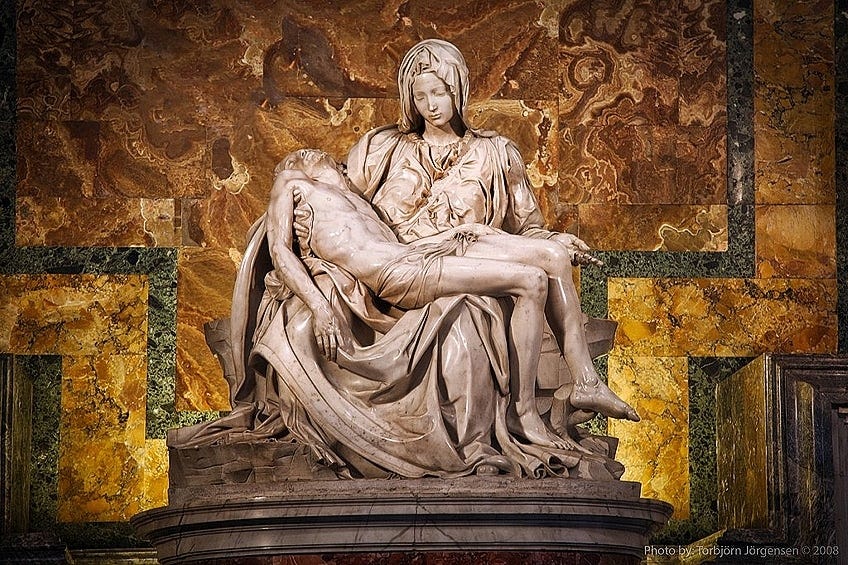
Critique without construction is cheap. So let me offer something better — and something the Church has already given us.
The classical Christian account is neither Platonic dualism nor the “ghost in a machine” Wright rightly resists. It is hylomorphism — from hylē (matter) and morphē (form). On this account, the soul is not a detachable substance floating inside the body. It is the form of the body — the principle that makes this particular body a living human rather than a corpse. It grounds personal identity. It is not an optional metaphysical accessory.
This means I am neither a trapped soul nor a reducible organism. I am a unified, ensouled body — a living psychosomatic whole.
From here, death looks different. If the soul is the body’s form, then death is not annihilation or replacement. It is rupture — an unnatural tearing of form from matter, a wound in creation. The soul’s persistence after death is real, sustained in Christ, yet incomplete. It longs for reunion, because embodiment belongs to its nature.
Resurrection, then, is not God discarding the old and drafting a new version from memory. It is the restoration and glorification of the same embodied person. No divine copy. No celestial 4D reprint. Resurrection transforms what already persists and it does not replace it.
This is why the great participatory tradition (theosis) — from Irenaeus to Maximus — could speak of recapitulation and deification without collapsing into dualism or reductionism. Christ assumes our nature in its fullness, heals it from within, and raises it. He does not overwrite it. He gathers it up and brings it to its intended end. Theosis perfects nature and it does not replace it. Participation presupposes something real to participate in.
The soul, then, is not a ‘ghost in the machine’. It names the depth of a person — the irreducible subject who receives existence from God and is capable of communion with him. Participation does not dissolve that subject. It secures it.
And this hylomorphic account does three key things.
It grounds personal persistence — the soul is the abiding form of our identity, held in Christ between death and resurrection.
It avoids escapism — salvation is not liberation from matter but the perfection of embodied life.
And it makes resurrection necessary and intrsinsic, not an ornamental decoration — because the human being is a body-soul unity, final salvation must restore that unity in resurrecition glory.
This works pastorally as much as philosophically. It is what you cling to at a graveside that can bear the weight of your gried. When someone dies, our hope is not that God has preserved a flawless memory of them. It is that the one who laughed, who wept, who held our hand is not gone into nothing. Death tears. But it does not delete a life.
So Christ reveals what we are. The soul explains how we remain. And resurrection completes what we were always meant to be.
.
I agree with what you have written - I have not read any of NT Wrights books- for me it is exactly as you say from a pastoral and hopeful perspective. Nothing made me so sure about the fact we have souls as when my dad died and the realisation that what made my dad my dad was no longer in his physical body- I have said to others who have not seen death close at hand that if anything was going to help convince about there being more than the millions of chemicals making up a body to being that person, it was witnessing the death of a loved one and seeing that what made that person that person had left them. Not sure this makes sense- I agree and am comforted by what you have written
Thanks Jason for this. I don’t have the intellectual or theological horsepower to follow it all, but I appreciate the depth of your scholarly work here. My observation is that the Holy Spirit tends to work in unexpected ways that are uniquely suited to his purposes. With imagination we can indeed expect the revelation that is the church will continue to expand and grow through the ages as the Spirit leads. The challenge, of course, is to keep it from being polluted and corrupted by things of the world which seems to be mankind’s relentless bent.
Jesus’s bodily resurrection is ample evidence (at least to me) that we are not reconstructed from God’s memory when our earthly bodies die. If we become disembodied memories, what’s to distinguish us from what artificial intelligence is becoming? Yikes!