



There is a passage from Caryll Houselander that has been quietly working on me, haunting me for the last few weeks. She writes that when someone is newly converted to faith — or newly reawakened to its meaning — it is like falling in love with God. And not in a gentle way, but in something far more dangerous.
“Everyone in the house will feel the presence, the danger of the Divine Lover… whose demands may be uncompromising, may turn the complacency of the middle way topsy-turvy…
He is the Pied Piper to the human heart.”
— The Reed of God
It is an unsettling image, and it is meant to be.
Because when someone really falls in love, life does not remain organised as it was; instead, it is automatically re-ordered around love. Diaries change without effort. Time rearranges itself. Energy and money flow differently. Clothes, holidays, and homes change. Priorities quietly but decisively shift. Other people notice. Sometimes they feel displaced. Sometimes unsettled. Sometimes mildly irritated and irked.
Love is never neutral. And it is never ever private.
Modern Western Christians have developed a rather middle-class habit of treating the Gospel as a form of spiritual life management. We tend to invite Christ into our lives not as a transformative force, definitely not as a disruptive one - God forbid, but as a sort of “Honoured Guest” who is expected to behave himself in the lounge of our daily routines.
The diagnostic question Caryll Houselander draws us into asking ourselves is whether we have allowed Jesus to become a hired consultant—a useful presence to be tapped for his expertise in “providence,” “well-being”, or “ guidance”—or whether we have truly surrendered to the disruptive intimacy of the Lover of our souls. And if we have others will definitely notice.
The Consultant Jesus is summoned when there is a crisis in the “parish of the self.” He offers a menu of options, provides a bit of emotional and psychological scaffolding, and then waits patiently in the spare room until his next summoning. He is safe, predictable, and entirely manageable, and he is on call 24/7.
The Lover, by contrast, is an intruder. Love, in its true theological sense, is not a feeling we “use” to improve our lives; it is a power that re-orders our world. A lover does not offer advice; a lover demands attention, presence, vulnerability, and a total reconfiguration of our priorities around them.
The tragedy of contemporary faith is that we have traded the wild, unpredictable terrain of the Spirit for the neatly paved cul-de-sacs of 'personal development.' We prefer a Christ who helps us manage our lives over a Christ who calls us to lose them.
Drifting and Shifting

Ignatian spirituality, in its bracing practicality, has very little interest, if any, in how sincere we think we are. Ignatius of Loyola was far less concerned with our self-perceptions than with what actually moves us—those hidden tides that order our desires, govern our choices, and quietly claim the geography of our attention.
The Arc of Desire
Many of us recall what it is to begin and renew a relationship with God with ardour. Perhaps it was a conversion, a retreat, or a sharp moment of crisis that yielded a crystalline clarity. In those seasons and moments, Christ felt not just close but compelling. Prayer was not a slot in a diary. It was the air we breathed, and the time we automatically entered. Scripture was not a text to be interrogated for promises of provision but was a voice that spoke life and relationship to us. Our lives seemed to bend themselves, almost effortlessly, around our relationship with God.
The Drift into Stagnation
But time, and the creeping domesticity of our souls, pass over and throughus. Without any dramatic collapse or grand apostasy, and without a conscious loss of faith, our relationship with God subtly changes its architecture and structure. We see how this happens in our earthly loves, too.
Relationships often begin with a disruptive love—a passion that upends our world and demands everything. Yet they can settle into a weary stagnation. The parent whose only interaction with their child is a request for money—a relationship reduced to a transaction. The marriage in which a partner is valued only for their proficiency in chores and household admin, with romance buried under a mountain of life’s “to-dos.”
The Subtle Shift
In our spiritual lives, a similar dissipation and fading can occur. Jesus remains a trusted friend, but no longer our centre of gravity. He becomes a support figure, someone we once loved deeply but now hold at a polite, respectful distance. Eventually, he might only be called upon for parking spaces, job opportunities, and relief from pain and suffering. The disappointments of life quietly relegate him to these support roles, and love fades into a kind of utility.
In time, the silence between Him and us grows so heavy that reopening conversation feels awkward—like old friends embarrassed by years of unresponded-to messages. Where do we even begin?
St. Ignatius would not rush to “fix” this with a frantic burst of spiritual activity. We’ve probably all tried that and know it doesn’t work in the long run. Instead, Ignatius invites us simply to notice. Which is easier said than done, but more powerful than we realise, because it taps into the fabric of the created order, the very nature of relationships themselves, and the heart of God’s desire for us.
Because what’s at stake isn’t our spiritual “performance,” but the very quality and nature of our lives. It is about a relationship. A loving Father, friend, or spouse doesn’t want a checklist; they want to be seen. Ignatius asks us to begin there. No rushing to fix things. No hiding behind apathy or excuses. Just awareness.
Love as the Engine of Formation

There is a fundamental truth about our humanity: we are not formed primarily by the accumulation of information, the rigours of discipline, or even the sincerity of our good intentions. We are formed, quite simply, by love—by that to which we repeatedly give ourselves, by the deep currents of our desire, and by whatever registers as most real in the marrow of our daily lives. Right now. Whatever our lives are ordered around, is being driven by our deepest love and desires. The driving desire to be secure, the fear of failure, and the protection from psychological pain.
The Architecture of Affection
Modern neuroscience, in its own dialect and method, has begun to confirm what the Christian spiritual tradition has always known: attention follows desire, and desire follows love.
The things that we love tell us what we are - Thomas Aquinas
You are what you love - Augustine
Neuroscience confirms Christian theology: what we love is what we do, and what we do shapes what we love. Our nervous systems are etched by patterns of attachment long before they are ever shaped by the content of our ideas. We are wired for relationships before we are ever trained in any beliefs.
In this sense, what we love becomes the invisible structure and shape of the soul.
Love acts as a kind of internal gravity. It is the force that reaches into the clutter of our minds and draws the scattered fragments of the psyche into a single, coherent orbit. Left to our own devices, we are often just a collection of competing impulses and anxieties.
But love brings order to the “inside” of us. It pulls our disparate parts together—our fears, our hopes, and our history—and holds them steady around a central point. It is not that love makes us perfect; it is that love makes us whole. It provides the steady centre we need to simply be.
There is a cosmological truth here. We do not discover ourselves by turning inward without end, but by what we love. We become ourselves through the objects of our devotion.
Like holding my new grandson in my arms for the first time yesterday.
Love moves outward from me, unannounced and unquestioned. I do not decide it; I find myself already given. To hold him. To cherish him. To care for him. To carry him into whatever life will bring. Nothing needs to be said. Nothing needs to be promised outloud.
It is all there—in the way I hold him, in the attention I give him. His eyes. His nose. His ears. His mouth. And suddenly my own life is being retold, passed on, through my son standing next to me and now through him.
Into my beloved grandson.
My life has fallen into the gravity well of this little bay boy, orbiting his existence held fast by love from which I will never escape.
Why We Resist — Even When We Want God

Our bodies and our beings are shaped for coherence. Familiar patterns feel safe, even when they quietly narrow our freedom. So when love invites a re-ordering, our nervous systems can experience this not as consolation, but as a threat.
This is why, in prayer, we sometimes notice movements of what Ignatius calls desolation:
a restlessness that makes it hard to remain
an avoidance of silence and the vulnerability of being alone with our own thoughts
a retreat into analysis—a cool review rather than a warm, attentive beholding
a preference for spiritual conversation about God over spiritual exposure before God
None of this means we are failing or resisting God. In Ignatian terms, desolation often arises not because God has withdrawn, but because love is loosening what once gave us a sense of control. What feels destabilising may be the very place where freedom is being offered to us.
This is why Ignatius teaches us to notice rather than correct. To stay with what is stirring, without haste or self-accusation. Noticing these movements is already a sign of God’s grace. It places us on the threshold of deeper desire—of what we truly want from, and with, God.
These movements are not obstacles to God’s presence. They are often the doorway through which consolation eventually returns—quieter, truer, and less dependent on our control.
Why Love Is the Risk We Avoid
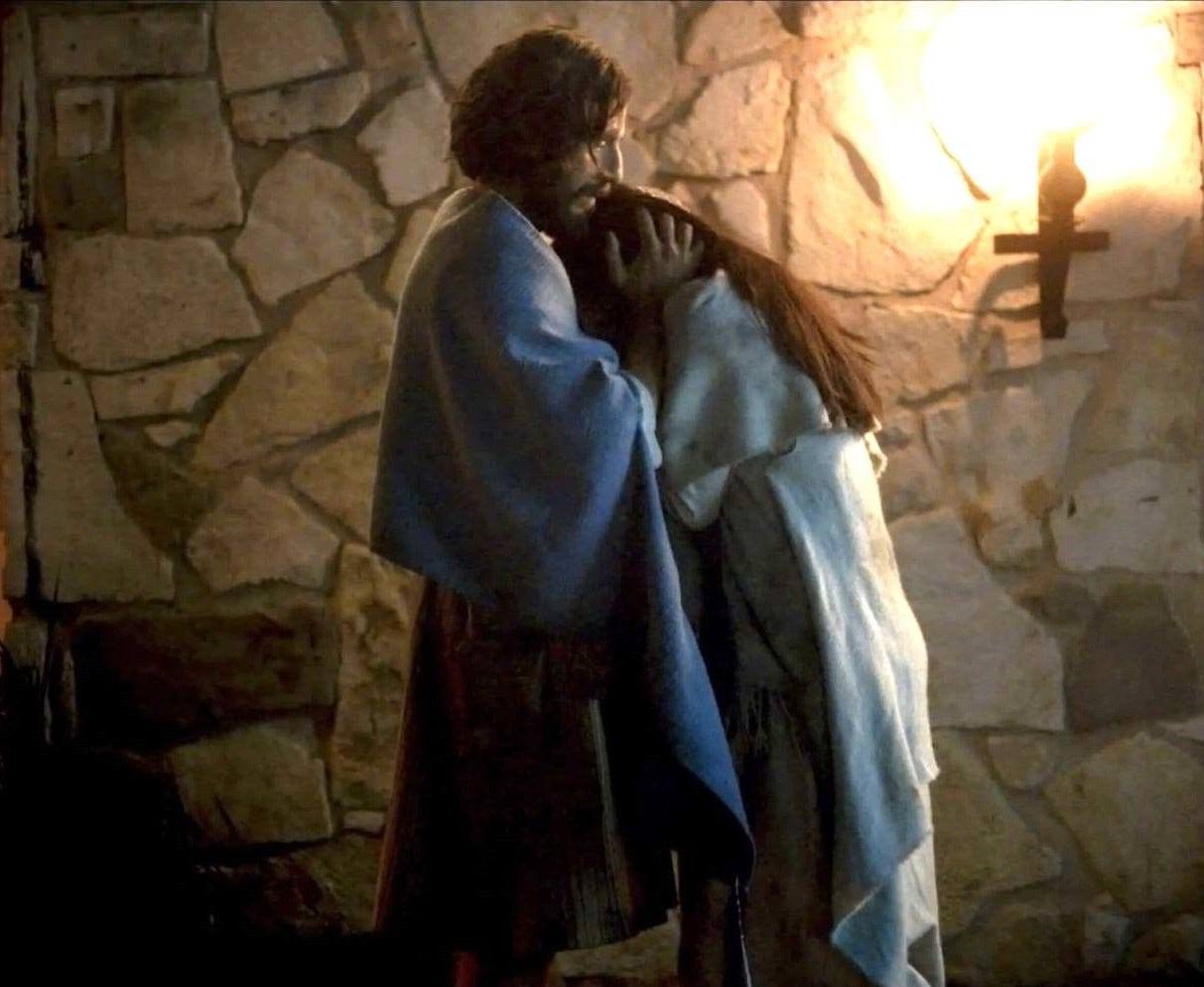
At some level, we all know this: the deepest cry of the human heart is to be loved — and to love in return. Not admired. Not approved of. Loved. Known and still wanted.
When we hear of someone famous dying, the most beautiful thing to know is that they were surrounded by those who loved them. If love carries us into the world, we hope it will carry us out—and bear us carefully all the days in between.
And yet, again and again, we protect and defend ourselves from precisely this.
We see it everywhere. The sad person who cannot receive love even when it is offered. The person who keeps control because control feels safer than dependence. The one who postpones love until circumstances are fixed, wounds are healed, identity questions are resolved, and reputations are secured. The cliched truths of so many novels and movies.
I’ll open to love when I’m less exposed. I’ll receive love when I’m more secure. I’ll risk intimacy when I feel safer.
But love never works like that. Ever.
Fear of loss. Fear of humiliation. Fear of being seen too clearly. Fear of having our carefully managed identities disturbed. Fear that if love rearranges us, we may not recognise ourselves — or be recognised by others. This is what love is.
So instead, we often choose to keep love manageable.
We spiritualise it. We therapeutise it. We keep it useful and domesticate it.
And yet the irony is this: it is love itself — especially the love of God — that reveals these defences in us. Not to shame us, but to heal us. Love alone has the power to show us where we are guarded, fragmented, divided — and to attend to all that it reveals.
Ignatius understood this. The Spiritual Exercises are not a programme for self-improvement. They are an exposure to love strong enough to tell the truth, and patient enough to wait for consent.
All love carries this risk. Not only that our circumstances might change, but that our actions might change — and more deeply still, that our identity might be re-formed. Love does not simply reorder our schedules. It presses toward the centre of who we take ourselves to be, to call us into who we were created to become.
That is why true love always demands something.
Not in the sense of coercion, but in the sense of insistence. Love asks for participation. It calls for surrender, not because it wants to diminish us, but because it wants to make us more of who we were meant to be.
Few hymns express this more clearly than When I Survey the Wondrous Cross. The first few verses focus on Jesus and his love for us. Then comes the final verse, where, having seen and appreciated Christ’s love for us, looks around, wondering what gift it might be to give in return, including all of creation itself. But concludes that even that would be an offering far too small, because:
“Love so amazing, so divine,
Demands my soul, my life, my all.”
That word demands can catch in the throat. It sounds excessive. Unsafe. And it is all that and far more. For it is the grammar of love. Partial love fragments us and opulls apart more. Managed love leaves us atrophied, too. Only total love integrates and creates.
This is not the demand of a tyrant. It is the claim of a Lover.
Christian spirituality has always known this. Augustine’s restless heart. Bernard of Clairvaux’s insistence that love grows by loving. Teresa of Ávila’s warning that prayer will cost us our illusions. John of the Cross’s insistence that love wounds in order to heal.
Love presses toward union, which is why we hesitate. And why we also long for it anyway.
To let ourselves be loved by God — really loved — is to risk being reordered at the deepest level of identity, being and daily life. It is also the only way we ever become who we are meant to be.
The Pied Piper still plays, and God’s love still calls us.
And the question beneath all our strategies, delays, and defences is not whether love will ask everything of us — it always will.
But whether we will trust that such love is, finally, the safest place to give it in return.
P.S. A spiritual director is trained to hold a prayerful, attentive space where you can notice and share your lived experience with God — even in the most intimate movements of the heart, including love.