


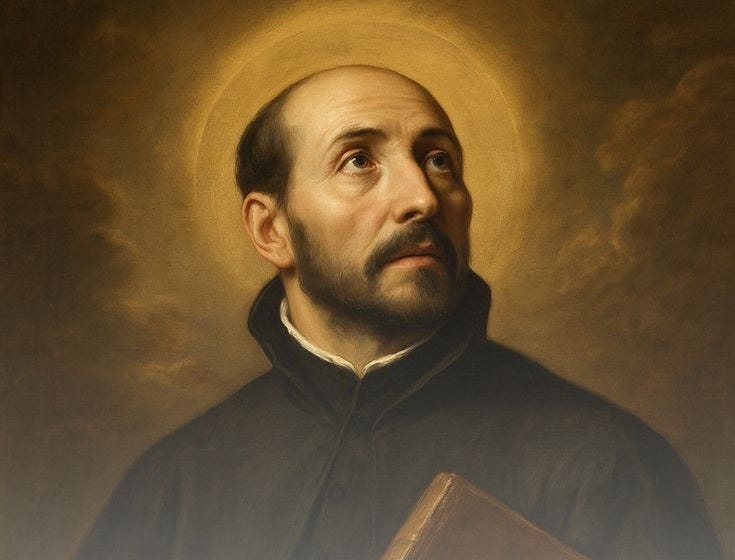
We ran out of chairs.
This past summer of 2026, at Wildfires, a charismatic festival that gathers thousands of Christians in a field in West Sussex, we ran out of chairs.1 Every morning and evening, the big top was filled with worship. One afternoon a smaller tent filled too. A few hundred people had come to my seminar on Ignatian spirituality, the way of prayer taught by the sixteenth-century Basque soldier who founded the Jesuits. Rows of chairs stretched out through the tent's open sides, every one taken, and another hundred or more people sat on the grass behind them, leaning in to listen.
The numbers surprised me, and I wondered whether all of this was new to them. So I asked. Who had heard of Ignatius? Who had heard of the Examen, his daily prayer of looking back over the day with God? Hands went up all over the tent. Many were already praying this way and had come to explore more.
That field was one of several signs.
When Kingsway, an evangelical publisher, invited me to write a book for Lent 2027, they asked for an Ignatian one because they were seeing growing interest in all things Ignatian. And at the London Centre for Spiritual Direction, which I have led for nearly two years, our longest-serving tutors tell me the same story. Twenty years ago, evangelicals were rarer on our courses. Now evangelicals of every stripe make up a major rump of our students.
Ten years ago, if you had told me that I would make the Spiritual Exercises, train as an Ignatian spiritual director and lead a centre that trains others, I would have laughed at you. I could not have imagined. Yet here I am, writing from inside the thing I am describing.
So why? Why would evangelicals, people like me who were in the past often taught to treat anything Jesuit with suspicion, now fill tents and training rooms to learn a Catholic way of prayer?
Here is my suggestion. Evangelicalism taught us to want a personal relationship with Jesus. Ignatius teaches a way to live one. When we step into Ignatian prayer, we find a house we recognise, and inside it the rooms we have been missing. And I have come to believe those rooms were built for every Christian.
Suspicions
In 1999 D. H. Williams, a Baptist minister teaching at a Jesuit university, wrote a book urging evangelicals to recover the early Church. He knew his readers. He subtitled it A Primer for Suspicious Protestants.2. The suspicion was already thawing. From Richard Foster’s Celebration of Discipline in 1978 to John Mark Comer’s rule of life and 24-7 Prayer’s Lectio 365 today, each generation has opened another door into the older house of the church.3
Ignatius was a suspect too.
In 1526 and 1527 church authorities at Alcalá and then Salamanca jailed him and examined his teaching. They suspected him of belonging to the alumbrados (”the enlightened”), who claimed direct experience of God.4 The man we learned to see as the spearhead of the Counter-Reformation was first suspected by his own Church of trusting encounter with God too much.
We have been crossing this threshold longer than most of us know. In the early 1970s, the evangelical writer Joyce Huggett and her husband agreed to speak at a student retreat, then discovered it would be held in a Catholic monastery. For evangelicals like them, she wrote, “the thought of darkening the doors of a monastery seemed as strange as planning a visit to another planet.” She later wrote that the visit would “change the direction of my spiritual pilgrimage”. Later, in a Jesuit journal, she explained why Ignatius “hooks Protestants”. She sorted her reasons under two headings, familiar territory and missing pieces of the jigsaw, and they still describe what evangelicals find today.5
Ignatius as an Evangelical
Anyone who writes seriously about evangelicals soon finds themselves quoting David Bebbington, a historian at the University of Stirling. In 1989 he set out four marks that have become the most widely used account of what holds evangelicals together, across all their streams and three centuries of history.6 Conversionism: lives need to be changed. Activism: the gospel is expressed in effort. Biblicism: the Bible is held in high regard. Crucicentrism: the cross stands at the centre. Run Ignatius through that quadrilateral, and he correlates with all four.
Start with the Bible. The Exercises lead a person through the Gospels scene by scene, from the Annunciation to the Ascension, praying each one with the imagination. Huggett found them “so bible-based that they might accurately be re-named ‘Biblical Exercises’”. One friend told her, “I’d never experienced eight days when the focus was simply the Bible,” and came away saying, “I have re-discovered the Bible.”
Then the cross. The Exercises give a whole Week, one of their four movements, to the Passion. And in the first meditation of the first Week, Ignatius asks the person praying to imagine Christ before them on the cross, and to ask:
what I have done for Christ, what I am doing for Christ, what I ought to do for Christ. (Exx 53)7
That is conversion, and anyone who has heard an evangelistic appeal will recognise it. Christ has given himself for me: what will I give him? The call to answer him with a whole life has passed from voice to voice since he first said “Follow me” beside the Sea of Galilee, through Billy Graham’s crusades to festival tents like those at Wildfires, where people still give their lives to Jesus. Ignatius built the Exercises around that call, and they end in a prayer of surrender, the Suscipe:
Take, Lord, and receive all my liberty, my memory, my intellect, and all my will. (Exx 234)
The first Jesuits went out from that prayer as missionaries and teachers to the ends of the known world. That is activism.
Most familiar of all is Jesus himself. Read the Jesuits, and you meet men and women who cannot stop talking about Christ. They pray with a sheer confidence that he is alive, risen and at work by the Spirit, and that anyone who comes to him will be met, called and formed into the person he made them to be.
So, Ignatius has us ask for the same grace again and again: to know Jesus from the inside, so that we love him more and follow him more closely (The Spiritual Exercises (SpEx) #104). Each time of prayer ends in conversation, made, he says, “as one friend speaks to another” (SpEx #54). This is the personal relationship with Jesus that we have always preached, given a shape we can practise every day.
The heart is familiar ground too. Over a few generations, evangelical worship moved from the head towards the heart, and Ignatius takes feeling seriously. Evangelicals whose traditions put the mind first and distrust feeling remain wary, and their worry is fair: feelings can deceive, and imagination can project flights of fancy. Ignatius shared that worry too. He wrote his rules for discernment to test what moves in us by its fruit. Christians, who already believe that God speaks, find in those rules a tested way of “distinguishing between spirits” (1 Corinthians 12:10).
Forgiven but unformed
Few theologians ever taught the gospel as a bare transaction, but many of us heard it that way. Jesus took my punishment. I am forgiven. That is true, and I will never stop being grateful for it. But when one picture of the cross becomes the whole of salvation, forgiveness comes loose from transformation. We knew we were forgiven. We were less sure we were being changed. Salvation became about praying prayers to go to heaven when we die, and disconnected from formation in everyday life. This is the ‘bar code’ Christianity Dallas Willard alerted us to.
Willard introduced the concept of ‘bar-code Christianity’—also called a ‘Gospel of Sin Management‘—in his 1998 book, The Divine Conspiracy. Willard used the supermarket scanner analogy to critique a transactional view of faith that reduces salvation to a legal label applied to an unchanged life, comparing it to how a scanner reads the exterior barcode while ignoring the package's contents.
Meanwhile, before being scanned into heaven, something else was forming us in everyday life. James K. A. Smith, whom many evangelicals read, explains that we are what we love and that we learn to love through repeated practices he calls liturgies.9 The shopping centre has its liturgies. So does the smartphone. Every day, they shape and steer what we want. A Sunday sermon cannot undo a week of scrolling, because information cannot counter a liturgy. Only another liturgy can.
Ignatian prayer is that liturgy, and it is disarmingly simple. Each evening, the Ignatian Examen exercise and prayer walks us back through the day with God, noticing where he was at work. Each time of prayer begins by asking God for what I want. Ignatius trains us to find God in all things, in the office, the kitchen, our hope, dreams and even our sin, as much as in church. And the doing is the point. Prayer forms us the way friendship does, through time spent together.
The innermost room of Ignatian Spirituality is participation. (Yes, I am about to quote Calvin in a piece about a Jesuit. Bear with me.) Calvin opens the third book of his Institutes like this:
as long as Christ remains outside of us, and we are separated from him, all that he has suffered and done for the salvation of the human race remains useless and of no value for us.10
Union with Christ was never a Catholic import. Paul longed to “be found in him, not having a righteousness of my own”, and to know Christ, “the power of his resurrection and participation in his sufferings, becoming like him in his death” (Philippians 3:9-10). Those two verses trace the whole shape of the Exercises. The first movement of the Ignatian Exercises is discovering a righteousness not my own, where we face our sin in God’s mercy. Knowing Christ is the second movement of the Exercises, walking with him through the Gospels. Sharing his sufferings is the third, at the cross. The power of his resurrection is the fourth.
So the Exercises refuse the shortcut from Good Friday to Easter Sunday. They walk us all the way into the life, death and resurrection of Jesus, until his story becomes the one we live in. We spend our lives trying to make ourselves, and the effort pulls us apart. In him we are put back together. I think of it as being re-membered.
The last of these rooms holds a companion. One person, a Spiritual Director, gives the Exercises to another; but Ignatius tells that guide to stand aside and let the Creator deal directly with the creature (SpEx 15), trusting Jesus to do his own work. Ignatian prayer is designed so the encounter depends on neither a platform nor a personality, but on direct encounter with the Lord. More broadly, Ignatian Spirituality flows from this core belief and practice.
Built for Everyone: Why this matters now
This reaches well beyond evangelicalism. No generation of Christians has had its desires shaped so relentlessly by screens it carries everywhere, and every tradition has its own ways of leaving people forgiven but unformed. Perhaps evangelicals feel the gap first because no one has often spoken more warmly of a personal relationship with Jesus.
Ignatius built the Exercises to adapt to a person’s age, education, and ability (SpEx #18), and to be prayed in the middle of ordinary life by people too busy for a retreat (SpEx #19). They suit the chief executive and the young mother, the professor and the person who left school at sixteen. When Pray As You Go, the British Jesuits’ prayer app, became a hit with North American evangelicals, its director said her Jesuit colleagues were surprised.11 Catholics, too, may rediscover their own inheritance because evangelicals came looking for it. Importantly, Ignatian spirituality and practice also place people within the Church of many kinds rather than against it, unlike some forms of post-church spirituality. It does not set people up against their current ecclesial locations and history.
The Rooms Ahead: What comes next
Over the coming weeks I will open these rooms one at a time.
The Magnificent Obsession. Why Jesuits cannot stop talking about Jesus, and what happens when you pray a Gospel scene as though you were standing in it.
A Relationship of the Heart. Can you trust what you feel in prayer? The sceptics get their say, and Ignatius offers a test, nearly five hundred years old, for telling God’s voice from your own.
Forgiven but Unformed. Why so many of us know we are forgiven yet feel unchanged, and what the shopping centre has to do with it.
Not Straight to Sunday. What Paul, Calvin and Luther knew about the cross that many of us hurried past.
You Become What You Pray. A fifteen-minute daily practice that can change what you want.
Contemplatives in Action. Who this is for, and the one thing you need before you begin.
Subscribe, and each piece will come straight to you.
So I End Where I Began
I think I know what drew the people to a seminar at Wildfires, because it once drew me. I was about halfway through the Spiritual Exercises, staying in a hotel during a training week with a group of pastors. We stayed up late talking about church and ministry, over some average hotel wine, and I went to bed with four hours before my morning prayer in the Exercises. I never needed the alarm. I woke early, eager to open my Bible and pray, for the sheer delight of meeting Jesus. My hunger for Scripture, for Jesus, for the Father and the Spirit, caught light that week, and several years later it still burns.
Two disciples once walked the road to Emmaus beside a stranger who opened the Scriptures to them. When at last they recognised him, they said to each other:
Were not our hearts burning within us while he talked with us on the road and opened the Scriptures to us? (Luke 24:32)
That is what I think the people on the grass in the field at Wildfires were reaching for. Not a technique, but Jesus, close enough to speak to, and a road long enough to walk with him.
Where to begin. You need not wait for the next piece. Pray As You Go, the British Jesuits’ free app, offers a short guided prayer every day. Try the Examen tonight: fifteen minutes looking back over the day with God, noticing where you felt close to him and where you felt far away, and talking with him about both. Read Gerard Hughes’s God of Surprises or Joyce Huggett’s Listening to God.12 And if you want to go deeper, find a spiritual director and ask about making the Exercises in daily life.
Next in Praying Like Jesuits: “The Magnificent Obsession”.
https://wildfiresfestival.com/wildfires/
D. H. Williams, Retrieving the Tradition and Renewing Evangelicalism: A Primer for Suspicious Protestants(Grand Rapids: Eerdmans, 1999). Williams, a Baptist minister, then taught at Loyola University Chicago. See the review in First Things, https://firstthings.com/?p=13650
Richard J. Foster, Celebration of Discipline: The Path to Spiritual Growth (San Francisco: Harper & Row, 1978); John Mark Comer, Practicing the Way (2024), and https://practicingtheway.org/about. Lectio 365 is the daily devotional app of 24-7 Prayer.
On his imprisonment at Alcalá and Salamanca, see “Ignatius Loyola”, New World Encyclopedia, https://www.newworldencyclopedia.org/entry/Ignatius_Loyola; on the charge of sympathy with the alumbrados at Salamanca in 1527, see “Alumbrados”, Wikipedia, https://en.wikipedia.org/wiki/Alumbrados. Ignatius tells the story himself in his Reminiscences (the “Autobiography”).
Joyce Huggett, “Why Ignatian Spirituality Hooks Protestants”, The Way Supplement 68, https://www.theway.org.uk/back/s068Huggett.pdf. All quotations from Huggett and her friend come from this article.
David Bebbington, Evangelicalism in Modern Britain: A History from the 1730s to the 1980s (London: Unwin Hyman, 1989), chapter 1. On the four marks as a standard definition, see “The Advent of Evangelicalism: Exploring Historical Continuities”, Christianity Today, June 2009, https://christianitytoday.com/ct/2009/juneweb-only/126-12.0.html.
Quotations from the Spiritual Exercises follow the public-domain translation by Elder Mullan, SJ (1914), cited by the standard paragraph numbers (SpEx).
George A. Aschenbrenner, SJ, Stretched for Greater Glory: What to Expect from the Spiritual Exercises (Chicago: Loyola Press, 2004).
James K. A. Smith, Desiring the Kingdom (Grand Rapids: Baker Academic, 2009) and You Are What You Love(Grand Rapids: Brazos, 2016).
John Calvin, Institutes of the Christian Religion, 3.1.1, trans. Ford Lewis Battles, ed. John T. McNeill (Philadelphia: Westminster Press, 1960).
“Jesuit prayer app is a hit with Evangelicals”, The Tablet, December 2022, https://www.thetablet.co.uk/news/16268/jesuit-prayer-app-is-a-hit-with-evangelicals.
Pray As You Go is free: see Jesuits in Britain, “Jesuit prayer app Pray As You Go turns 20”, https://www.jesuit.org.uk/news/jesuit-prayer-app-pray-as-you-go-turns-20-serving-a-global-community-of-over-half-a-million. Gerard W. Hughes, God of Surprises (London: Darton, Longman and Todd, 1985); Joyce Huggett, Listening to God (London: Hodder and Stoughton, 1986). ↩