


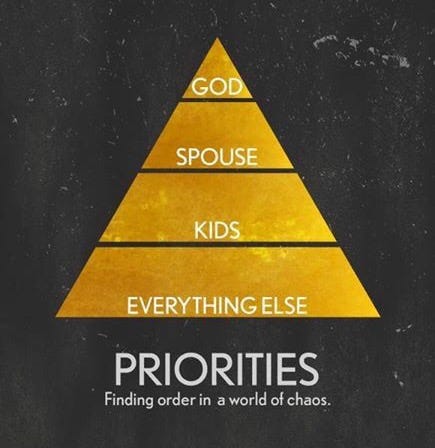
Anyone who has spent time in church has met the list. God first, family second, and then work, or church, or yourself, depending on who was preaching. It turns up at men’s breakfasts and fits neatly on a coffee cup or T-shirt, which perhaps ought to have been our first warning. It is also, I believe, impossible to live, and it always has been.
To be fair, the list began life as a correction, made with good motives. An earlier generation of Christian leaders put God first and ministry a very close second, and their families paid for it. Spouses ran households alone. Children grew up with the sense that the church needed their parent more than they did. As the damage of this ranking manist the deck was reshuffled, and family moved up a place. Marriages benefited, for which we should be grateful. But the new arrangement kept the old one’s deep and fundamental flaw.
It still ranked, and ranking does not work.
Life does not come in boxes
The church seldom invents its anxieties; instead it borrows them, usually a decade after everyone else. The priority list belongs to the world of the colour-coded diary, and shares its touching faith in neat quadrilaterals. Life, though, does not come in such boxes. A sick child, an overflowing inbox, a deadline, and the morning’s prayers all arrive on the same Tuesday, in no particular order and often all at once. Nobody lives by a ranked list. We live the day at hand as it comes.
And what exactly do we mean when we say God comes first? A strong feeling that he is first place? Or do we mean actions that prove it: an early quiet time? Our tithe? Turning up on Sunday? At best, a ranking is a rough way of sharing out our time, money and energy. At worst, it is a rather good way to kid ourselves and gives us an alibi for self-deception. We tell ourselves our work is for God and keep working too hard because we are frightened, insecure, or carrying wounds we would rather not look at. We say God comes first, and then use God to get what we want: success, security, children who turn out well. Augustine spotted this trick sixteen centuries ago: we were made to enjoy God and use things rightly, but we keep getting it backwards.
So what really comes first for us? Something always does, and more often than we care to admit it is ourselves. Underneath, at the bottom of who we are, are our drives for life. The Trappist monk Thomas Keating called these drives our “emotional programs for happiness”: security and survival, affection and esteem, power and control. We lay them down in early childhood, around needs we could not meet for ourselves, and they keep running long after we learn to say the right things in church. Whatever we recite on a Sunday, these needs tend to run from Monday onwards.
Which brings me to my point. Our lives are already perfectly ordered.
Every life is arranged, with a regularity that would put most church programmes to shame, around what we most want and what we most fear. Augustine put it in four Latin words, pondus meum amor meus: my love is my weight. We fall towards what we love as surely as a stone falls to the ground.
Seek first: how Jesus orders a life
This, I think, is why Jesus speaks as he does in the Sermon on the Mount. He starts by making a diagnosis: “For where your treasure is, there will your heart be also” (Matthew 6:21). Our hearts have already followed our treasure. Then he names what lies underneath this, the fretful and stressful business of what we shall eat and drink and wear, which is Keating’s security programme in a first-century dress. Only then does the invitation come: “But seek ye first the kingdom of God, and his righteousness; and all these things shall be added unto you” (Matthew 6:33). Jesus does not demote food and clothing. He gives them back to us as gifts, not as things we must clutch to stay alive.
Someone will point out that Jesus named a first and a second commandment. But look at how it happens. A scribe asks him, “Which is the first commandment of all?” (Mark 12:28). He wants a ranking. Jesus answers with love of God and love of neighbour, and then adds, “There is none other commandment greater than these.” These, plural: the two cannot be prised apart. Love of God, of neighbour and of self turns out to be one movement of the heart.
Love, for love, by love: what Ignatius offers
Ignatius of Loyola understood this better than most. His Spiritual Exercises, a handbook for a month of guided prayer, open with what he calls the Principle and Foundation. Put crudely, it says we are made in love, by love and for love. His own words are rather plainer:
Man is created to praise, reverence, and serve God our Lord, and by this means to save his soul … desiring and choosing only what is most conducive for us to the end for which we are created.
What Ignatius does not give us is a list. Family, work, church, health and reputation all sit together among “the other things on the face of the earth”. Each is to be used insofar as it helps us toward love, and let go of insofar as it gets in the way. He calls the freedom to do this indifference, a word that sounds faintly emotionally repressed to modern ears. He actually meant something warm: not being held hostage by any one attachment, so that we are free to want what love asks of us. We might use the more modern word, differentiated, what Ignatius meant.
The Foundation’s first gift, I think, is permission to be honest. In prayer, before a God who looks on us with love, we can name our desires, our fears and our attachments without dressing them up. Ask yourself what comes first, and you will probably get a pious answer. Ask what you are most afraid of losing, and you are more likely to get a true and honest one.
And the Exercises begin with being loved, long before they ask anything of us. The more we discover how much God loves us, the freer we become to give ourselves back, and the order we had hoped the list would supply begins to grow from that centre instead. Scatter iron filings on a sheet of paper and no amount of tidying will make a pattern. Slide a magnet underneath, and they arrange themselves.
Back to Tuesday
What does this look like on an ordinary Tuesday in our week? Not, I think, a newly ranked schedule.
Take the school sports event, and the church prayer meeting that clashes with it, as it always seems to. A rule settles that in a second. Love may go one way this year and the other way next, and the child, who is nobody’s fool, will know whether a parent came because the list said so or because they wanted to be there. And when, on a family evening, a hand creeps towards a smartphone, love asks what anxiety and desire is doing the reaching.
So at the end of the day, rather than asking whether we kept our ranked priorities, we might borrow a better question from the Examen, the short evening review that Ignatius taught: where did love move me today, and where did fear?
George Herbert, the deeply Anglican of poets, ends his poem Love (III) with a guest who has run out of excuses for refusing God’s hospitality. Love will not take no for an answer, and the poem ends: “So I did sit and eat.”
That seems to me where a rightly ordered life begins. Not with a list, but at a table. We were never meant to rank our lives. We were meant to be loved into order.
Such a good reminder - the question- what am I afraid to lose- is a tough and necessary one to answer…
Thank you for this and for posing an excellent question, what am I most afraid of losing.
Some quiet and radically honest introspection is called for, I agree.
And while I also agree with much of what you wrote, I see something different in how Jesus spoke of love and the ordering of our affections and the commandments of God.
“‘The most important one,’ answered Jesus, ‘is this: “Hear, O Israel: the Lord our God, the Lord is one. Love the Lord your God with all your heart and with all your soul and with all your mind and with all your strength.””
Mark 12:29-30
That seems to me, at least, that there is a prioritising of loves, although not a prising apart. If we deign to treat those around us - family, friends, neighbours and enemies - without love, then that challenges the truthfulness of any assertion that we are loving God first.