


When I was young, a promise was held out to me as it was to so many: if you want to, you can be anything you want to be. That was the dream. I reached for it with both hands. I had to.
I grew up in a house of violence and abuse, chronic and sustained, and my parents were its source. Their lives were coming apart, and they tore ours apart with them, in ways a child could neither understand nor stop. So I did what many children in that place do. I defined myself against them. Whatever they were, I would not be.
There were many doors for escape that opened as the years went by. I don’t fully know why I took the ones I did, only that they fitted me, and they still do. Books were the first. They offered an immediate escape from the world I was trapped in, into places I would never reach and lives I longed to live: poems and stories of rugged individuals who made their own way in the world and found freedom and purpose on the far side of their circumstances. Somewhere in those years I heard William Ernest Henley’s “Invictus.”1 It reached through my circumstances and spoke to me as if I had written it myself:
I am the master of my fate,
I am the captain of my soul.
I believed it. I needed to. For a boy in that house, self-creation was not pretentiousness. It was a lifeboat.
Then, at seventeen, a different offer arrived. It is the oldest offer Christianity makes, and in one form or another it stands near the start of the great Christian catechisms. The Westminster Shorter Catechism says that our chief end is “to glorify God, and to enjoy him for ever.”2 The Catholic catechism puts it as a question and answer:3
Why did God make you?
God made me to know him, to love him and to serve him in this world, and to be happy with him for ever in heaven.
To learn that God is God and we are not, and to order our lives around that truth. And for that truth to be the most freeing, life giving disposition for our lives.
Scandal: The oldest offence of Christianity
Many people assume the scandal of Christianity is to say that you will not go to heaven unless you pray the right prayer. I have come to believe the real scandal is very different and for many much harder to hear.
You are not free to be whoever you want to be.
That is the dream I was raised on, turned upside down, and it is what the catechism answer means. In one sentence the catechism tells us that we did not make ourselves and were not made for ourselves. This has never gone down well. In the Garden of Eden the serpent offered its exact opposite: “You will be like God.”4 We have been reaching for that demonic promise ever since.
But the same answer holds an offer the self-made dream never could. The only real freedom is found in discovering who we are in Christ, and no one in this life has fully plumbed the depths of who they are in him.
The scandal of Christ is old. What may have changed is the intensity of our reaction to it.
Try hearing it now. You are not free to be whoever you want to be. God is God and you are not. You were made by God and for God, to know him, love him and serve him. That may make us uncomfortable now in a way it perhaps did not in the past. We might find it hard to imagine sharing it with friends and family as good news, because we can already hear how it would land with them.
Serve? Who decided that? My life is mine to shape: my choices, my identity, my story. The sentences of the cathechisms do not sound like an offer. They sounds like a hostile takeover, as if someone larger had walked into the house you built and started giving orders.
Here is a diagnostic for us. Notice your own reaction, and the reactions of the people you know to this catechetical understanding. For all of us, the response to that sentence tells us more about ourselves than it does about God. Whatever offends us is the diagnosis.
Self-made: The fortress we build
For many of us, the making of ourselves has been vital. It was for me, when I was trying to escape my childhood. Many people have been crushed by identities pressed on them from outside: by families that could not let a child grow, by class, by institutions, and by churches that used God’s name to control. The modern insistence on authenticity is often a protest against real harm, and those of us in the Church should be the first to confess how often we caused it.
But somewhere along the way the protest became a programme. Freedom from false identities turned into an obligation to manufacture a true one. Look within, find your desires/passion/bliss, re-name yourself, and build a life that expresses what you find. There is a word for this: the autopoietic self, the self that makes itself.
The trouble is that a self-made self has to be defended. If I built it, I must also guard it, because no one else will vouch for it and underwrite it. So the self-made life becomes a fortified, its walls raised in opposition and kept standing by vigilance. It needs to be seen, affirmed and followed to feel real. Our hunger for validation is less a moral failure than the pertual watch we must keep on battlement walls of our identities. And the watching over ourselves never ever ends.
I can see those walls all around me in the lives of others. Almost no one builds them out of wickedness. We build them because we are afraid. I see them in the wider Church, which has learnt to build platforms and brands like everyone else.
And yes, I see them in myself.
I would love to tell you that I said yes to God at seventeen and the self building stopped. It didn’t. I received the offer declared in the catechism and then spent many years trying to secure myself within that through control, anxiety and vigilance. I had surrendered to God, but I kept the habits of a boy who had learned that safety was something you built yourself and defended at any cost.
I was like an adopted child. A child who comes into a new home after great loss rarely feels at home straight away. The house may be safe, but the body, mind and spirit has not yet been told. So it was with me. I stayed hypervigilant, always trying to be useful, trying to prove my worth, believing that if I cared enough for others, I would be safe in this new wonderful place.
God was patient with me, and kind, and worked alongside me the whole time. But I was still living in the fortress from my childhood, and it took me years to surrender, to heal and to be free: to let go of the self I had built to keep me safe, and receive the self God had made.
Henley’s Invictus poem told the truth about my circumstances. But he did not tell the truth about me. I was not the master of my fate, and every time I tried to be, I did myself more harm. The safe self I was building kept me trapped. It stayed centred on my parents, on the past, and on everything my childhood had lacked. A self defined against them still had them at its centre. And while I stood guard, I could not open the door to the one thing I most needed: to discover who I had always been meant to be in Christ. Safe and at peace.
I suspect I am not alone. Plenty of us have said yes to God and kept the keys to our fortresses of self-creation.
Ignatius opens his Spiritual Exercises with what he calls the Principle and Foundation, the ground on which the whole of the Spiritual Exercises stand: “Man is created to praise, reverence, and serve God our Lord, and by this means to save his soul.”5 In 1985, Jacqueline Bergan and Marie Schwan turned this into a prayer that begins:6
Lord my God, when your love spilled over into creation,
You thought of me.
I am from Love, of Love, for Love.
Those three prepositions hold the whole Christian account of what a person is. From Love: I did not begin myself. Of Love: what I am made of was given, not chosen. For Love: my telos, the end I was made for, lies beyond me. Self-creation reverses each one, such that I come from my own choosing, I am made of my own choices, and I live for my own fulfilment.
God-made becomes self-made.
So when the catechism sounds like a threat, it is because we can only imagine God as a rival, a bigger self competing for the same ground, so that every inch he claims is an inch we lose. Henley names this god exactly. He thanks “whatever gods may be” in passing, then defies them. He even borrows Jesus’s own words, “strait is the gate,”7 only to declare that they do not matter. We picture a rival God because we have taken his place, and the gods compete.
But the Creator is not one more power jostling for space in the world.8 A plant does not compete with the sun. The more light it receives, the more fully it becomes a plant.
I am not saying that people who struggle with who they are are simply proud, or that receiving your identity means accepting whatever others impose upon you. Inhabiting and receiving the Principle and Foundation frees us for faith and life in Christ, and from every other claim on our lives, because it answers to God alone.
Recapitulation: The Son in the far country
And here the scandal becomes the most beautiful thing I know. The catechism’s offer is not a takeover after all. We are not being controlled or used. We are being invited into a relationship with a Person. Self-creation makes us captive to ourselves, and it forces every relationship to bend to the will of the self we have made. Losing ourselves in God does the opposite. It opens us to him, to others, and at last to who we really are.
The Nicene Creed confesses the Son as “God from God, Light from Light.” He has nothing he has not received. He is from the Father, of the Father and for the Father, so “from Love, of Love, for Love” describes Christ before it describes any of us. Irenaeus of Lyons said that Christ recapitulated humanity, summing up our story again in himself.9 Where Adam grasped at equality with God, Christ did not count it something to be grasped.10 He is the one human being who has fully known, loved and served the Father, the catechism’s answer made flesh.
It cost him everything. In Gethsemane the Son, who had received all that he was from the Father, prayed with sweat falling like drops of blood, “not my will, but yours, be done.”11 The next day he went further into the far country than any of us will ever go, to the place where he cried out that God had forsaken him.12 There is no abandonment he has not entered. The far country is where we went to find ourselves, and it is where we lost ourselves. And the moment we realise where we are, lost in our self-creations, we find he is already there, waiting for us.
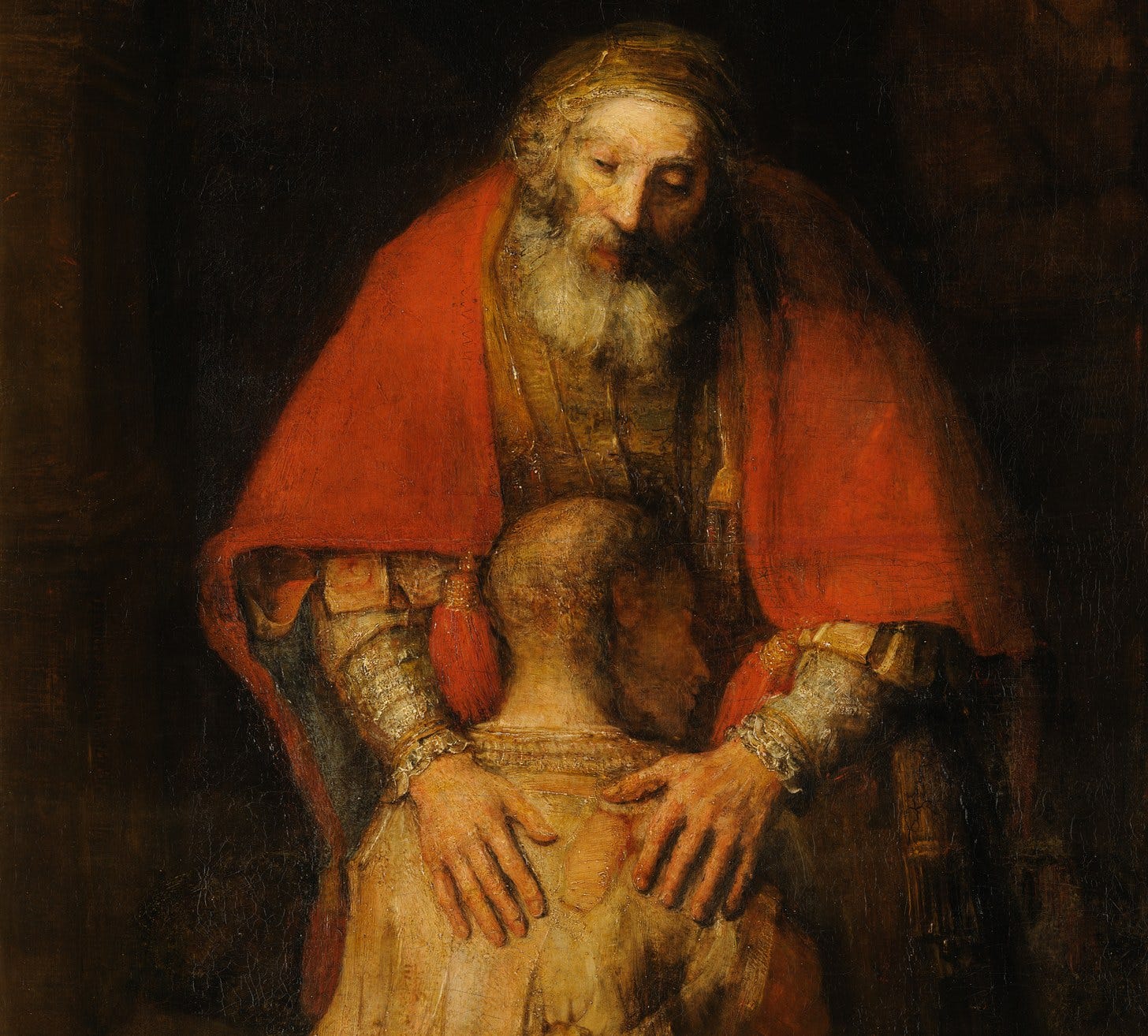
Some years ago, while I was praying the Spiritual Exercises over many months, I sat one morning in the early hours in the chair in the corner of my study where I usually prayed. I was meditating on the parable of the prodigal son, and for the first time I felt, deep down inside who I am, that I was safe. At home. Held. Owned by the Father’s love.
In that prayer time, I turned the story over in my heart and mind. And it was as if the Father said to me:
You are the son of a prodigal son. Your father abandoned you in a far-off land. I send my Son to find and rescue you. It just took you a while to find your way home.
Christ had walked all the way into the far country my father left me in, and at seventeen he found me there. Then Jesus began to bring me home. But the road was long, and I walked it still braced for danger. I had never been safe, so I tried to make myself safe. I worked too hard. I held on too tightly. I carried the anxiety and depression that come from trying to control everything. He walked every mile of it beside me. Picked me up when I fell down. Rescued me again and again, when I was in danger. It took me a long time to arrive home to the Father’s house, to the Father himself, and to the self he wanted to give me that I could never make.
So I wonder what self you are carrying. What walls have you raised, and what are they keeping out? Think of the people you love, working so hard to define themselves, assert themselves and hold it all together, and how fragile it all is. Think of what it is costing all of us, as a society that has asked every person to be their own maker and their own guarantor.
Perhaps that is why this old, offensive sentence matters more now than it ever has:
God made me to know him, to love him and to serve him.
Earlier I said we might find it hard to imagine sharing it with friends and family as good news. But it is good news, though never a comfortable one. To be from Love, of Love, for Love is not a sentiment to admire. It asks for everything. Ignatius begins the Exercises with the Principle and Foundation, and ends them with a prayer that erupts in response to accepting an identity received from God.13
Take, Lord, and receive all my liberty, my memory, my understanding, and my entire will.
That is the scandal: the gates of our self-made fortress opened, the defences laid down, the keys handed over, and our whole selves abandoned to Jesus. And that is its beauty, because the One we abandon ourselves to thought of us before we were, and has already come all the way into our far country to bring us home. The invitation is to hear it, to receive it, and to share it.
So I end where I began, with a boy, a dream and a poem. Henley was right about the night. He was wrong about the captain. I am not the master of my fate or the captain of my soul, and I no longer need to be. I was never free to be whoever I wanted to be. But I am free to be a son of the Father.
I am from Love, of Love, for Love, and I have come home.
William Ernest Henley, “Invictus” (1888). https://www.poetryfoundation.org/poems/51642/invictus
Westminster Shorter Catechism, Question 1. https://learn.ligonier.org/articles/westminster-shorter-catechism
A Catechism of Christian Doctrine (the “Penny Catechism”), with Canon Cafferata’s commentary. https://www.catholicapologetics.info/thechurch/catechism/Cafferata.htm
Genesis 3:5.
Ignatius of Loyola, Spiritual Exercises 23.
Jacqueline Bergan and Marie Schwan, Love: A Guide for Prayer (1985).
Matthew 7:14.
See Kathryn Tanner, God and Creation in Christian Theology (Oxford: Blackwell, 1988).
Irenaeus, Against Heresies 3.18.1.
Philippians 2:6.
Luke 22:42.
Mark 15:34.
The Suscipe, Spiritual Exercises 234. https://www.ignatianspirituality.com/ignatian-prayer/prayers-by-st-ignatius-and-others/suscipe-the-radical-prayer/
Thank you Jason. I love these: "I am from Love, of Love, for Love."
And, "A plant does not compete with the sun. The more light it receives, the more fully it becomes a plant."
Brilliant, again. And a message I am not hearing elsewhere. I hope you are gathering all these thoughts into a book?