


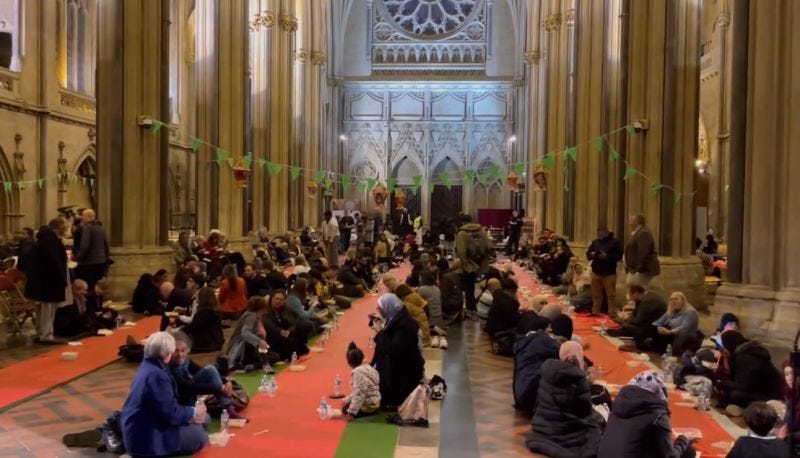
Bristol Cathedral was consecrated in 1148. Consecration is the act of setting aside land or a building for sacred use in perpetuity. For the third year in a row, the cathedral hosted a Grand Iftar — a communal meal where Muslims gather at sunset during Ramadan to break their fast together.1 Cathedrals hosting Iftars have become increasingly common.2
During the gathering, the Adhan, the Islamic call to prayer, was recited:
Allah is the greatest.
I testify that there is no god but Allah.
I testify that Muhammad is the messenger of Allah.
Come to prayer.
The Adhan not only marks the time for prayer. It also proclaims Islamic belief and establishes the presence of Islamic worship within a physical space. Within Islam, this confession also stands alongside a rejection of the Christian belief that Jesus is the Son of God.
And when we hear that a cathedral has hosted such an Iftar meal during Ramadan, people notice very different things.
Some see a generous gesture of welcome. A moment of hospitality in a world that often forgets how to greet the stranger. There is something noble in the instinct to open a door, to share bread, to create a place where difference does not immediately become division.
But beneath the surface of such moments lies a deeper question.
It is the question of what kind of place a cathedral actually is.
For some, a cathedral is essentially a symbolic place. A beautiful building, heavy with history, belonging to the Church yet also part of the city's civic life. If that is how one understands it, then the space becomes generous and flexible. Many kinds of gatherings can be welcomed there.
But others sense something more.
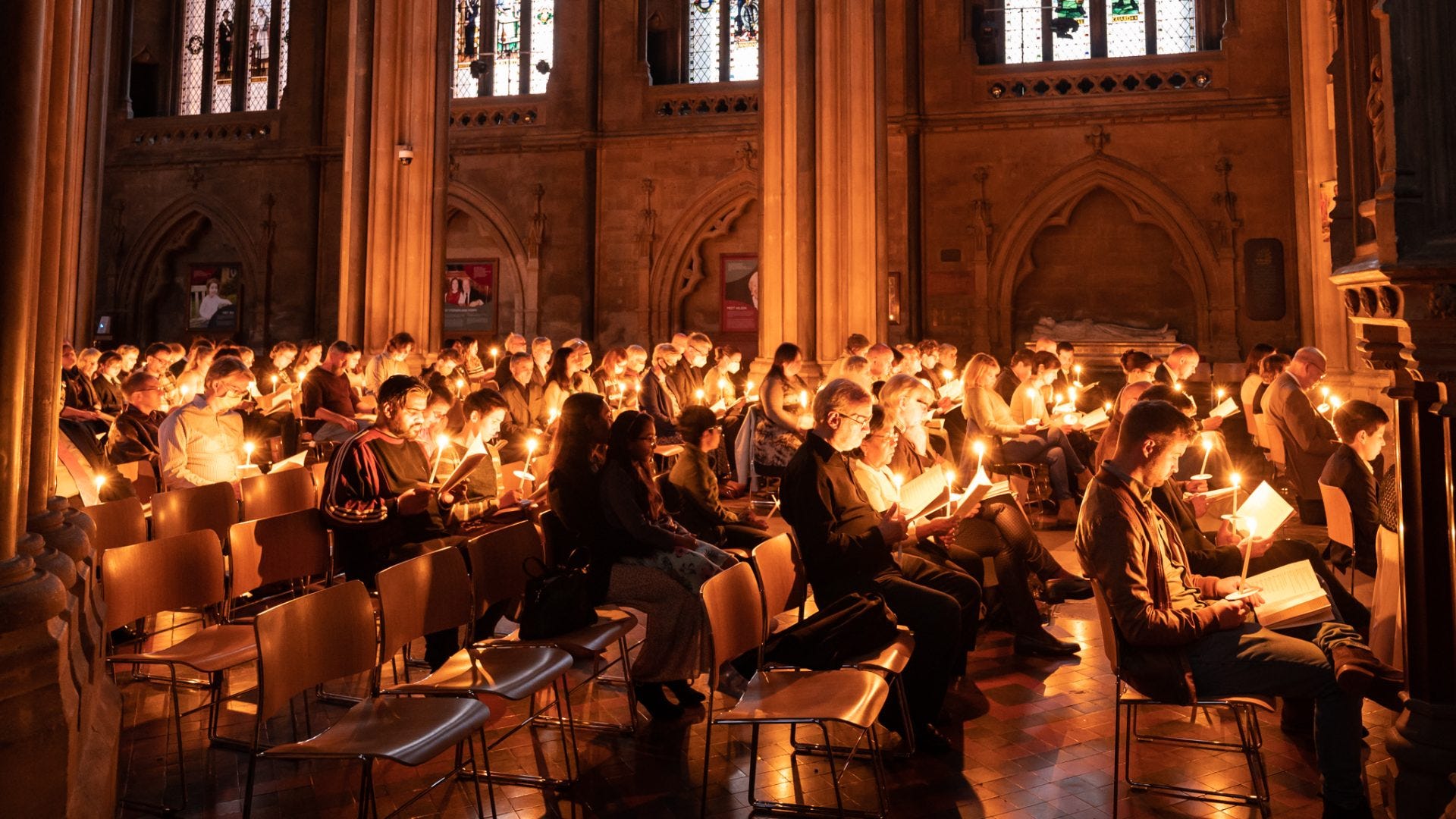
A cathedral is not simply built of stone and glass. It is shaped slowly through the centuries by prayer. Through the rhythm of Eucharist, through whispered confessions, through grief carried to the altar and hope sung into the rafters. Over time, a place like this gathers a depth of presence. The air becomes thick with memory and devotion.
In the old Celtic language, people sometimes speak of thin places—places where the veil between heaven and earth seems somehow more open. Cathedrals can become like this, not because of architecture alone, but because of the long fidelity of worship offered there.
This is why some music belongs easily in such spaces. Sacred song does not interrupt the prayer of a cathedral; it continues it. But when another religion’s act of worship is spoken within that space, something different occurs. And so the question that arises may not truly be about Muslims at all.
It is about how we ourselves understand the sacred.
What do we believe happens in places where generations have come to seek God?
If we feel no tension at all, perhaps it is because we have come to see such places mainly as symbolic — beautiful, meaningful, but ultimately interchangeable.
But if something within us hesitates, if there is a subtle sense that the atmosphere of the place has been disturbed, that instinct may be telling us something about the nature of sacred space. Some rooms in the house of the soul are meant for particular kinds of presence.
Moments like this reveal something discerning about us. They show us how deeply we believe that the sacred can dwell in a place, and what the sacred is for us.
And there is another sacredness worth remembering.

For many people, a cathedral is not merely a landmark visited by tourists. It is their church. It is where they kneel, where they light candles, where their prayers gather week after week like small flames.
I wonder what it is like for them to return to that familiar stillness, knowing that within those walls another confession of faith — one that speaks differently of Christ — has also been spoken. Perhaps they were glad, perhaps they were disturbed.
And perhaps the deeper question is not about the event itself.
It is about how awake we still are to the mystery of the sacred that dwells in place, and what that means for us.
Perhaps the most meaningful response is not to rush immediately toward judgement, but to enter a moment of quiet discernment.
Events such as this have a way of revealing something about the landscape of our own hearts. They show us what we notice, what unsettles us, what feels natural, and what feels somehow out of harmony.
So it may be worth pausing for a moment and asking yourself:
When you hear that an Islamic prayer was spoken in a cathedral consecrated for Christian worship, what stirs within you?

Is there a sense of peace about it — a feeling that such gestures are simply expressions of welcome and generosity?
Or does something different arise — a hesitation, perhaps even a subtle grief, as though the deep consecration of the place has been unsettled and the sacred atmosphere of the space has been wounded?
Neither reaction should be dismissed too quickly or railed against. Discernment begins by listening carefully to what moves within us.
Sometimes our response reveals how we understand hospitality and our relationship with those who believe differently from us. At other times, it reveals something about how deeply we believe the sacred can inhabit a place — how prayer, offered across generations, can gather and shape the atmosphere of a space.
In this sense, the event itself becomes less important than the awareness it awakens within us.
Perhaps the real invitation is simply this:
to sit with what we feel,
to listen for what our reaction reveals about our own faith,
and to allow that awareness to deepen our understanding of the sacred.
Sometimes it is through such moments that we discover what we truly believe about God, about worship, and about the places where heaven and earth seem to lean a little closer together.
In discerning moments like this, it seems only fair to begin with generosity.
I suspect those who organised the event were genuinely trying to be welcoming. In a divided world, the instinct toward hospitality is a good and humane one.
And yet, as I sit with it, something still feels misplaced.
A cathedral carries the long memory of Christian prayer. Over centuries, it has been shaped by the worship offered there. When another confession of faith is spoken in that space — even with the best intentions — it can feel as though something sacred has been disturbed.
Not maliciously. But perhaps unknowingly, in the wrong room of the Christian house.
—
p.s Last year 2025, was the big year for Cathedral and Iftars, with St Paul’s and Bristol,
UK Cathedrals Hosting Iftars
The most frequent and notable hosts include:
Manchester Cathedral, Southwark Cathedral, Bradford Cathedral, Coventry Cathedral, Blackburn Cathedral
Online tickets for 2026 at Bristol appeared on Eventbrite, but not on the Cathedral’s website. Iftars have definitely taken place in the previous two years.
St Paul’s hosted an Ifta in previous years. Other cathedrals in the last few years doing the same include Manchester Cathedral, Southwark Cathedral, Bradford Cathedral, Coventry Cathedral, and Blackburn Cathedral.
For me I react with “outrageous!”. There are plenty of ways to demonstrate solidarity but not in a place of Christian worship.
Interesting perspective and thoughts. I genuinely can argue for both sides on this one. On one hand, hospitality is a good thing--a sacred duty even. On the other hand, the idea of sacred, thin-spaces is legitimate. This goes with the question of whether the Vatican should have a place for Muslims to pray as well. On one hand, it might give true believers a place to worship God without separating themselves from their families. On the other hand, it is a place of worshiping the Triune God. But if God dwells in mankind, not in the structure of a temple anymore then does the structure matter? Thanks for bringing this question up. If I was leading it, I might offer a meal, after the prayers. A space of welcome, but not necessarily a space of Islamic prayer. This reminds me of a mosque/catherdral/temple in Cordoba, Spain. Have you seen it? It is an amazing place to visit that challenges our perspectives... https://en.wikipedia.org/wiki/Mosque%E2%80%93Cathedral_of_C%C3%B3rdoba