


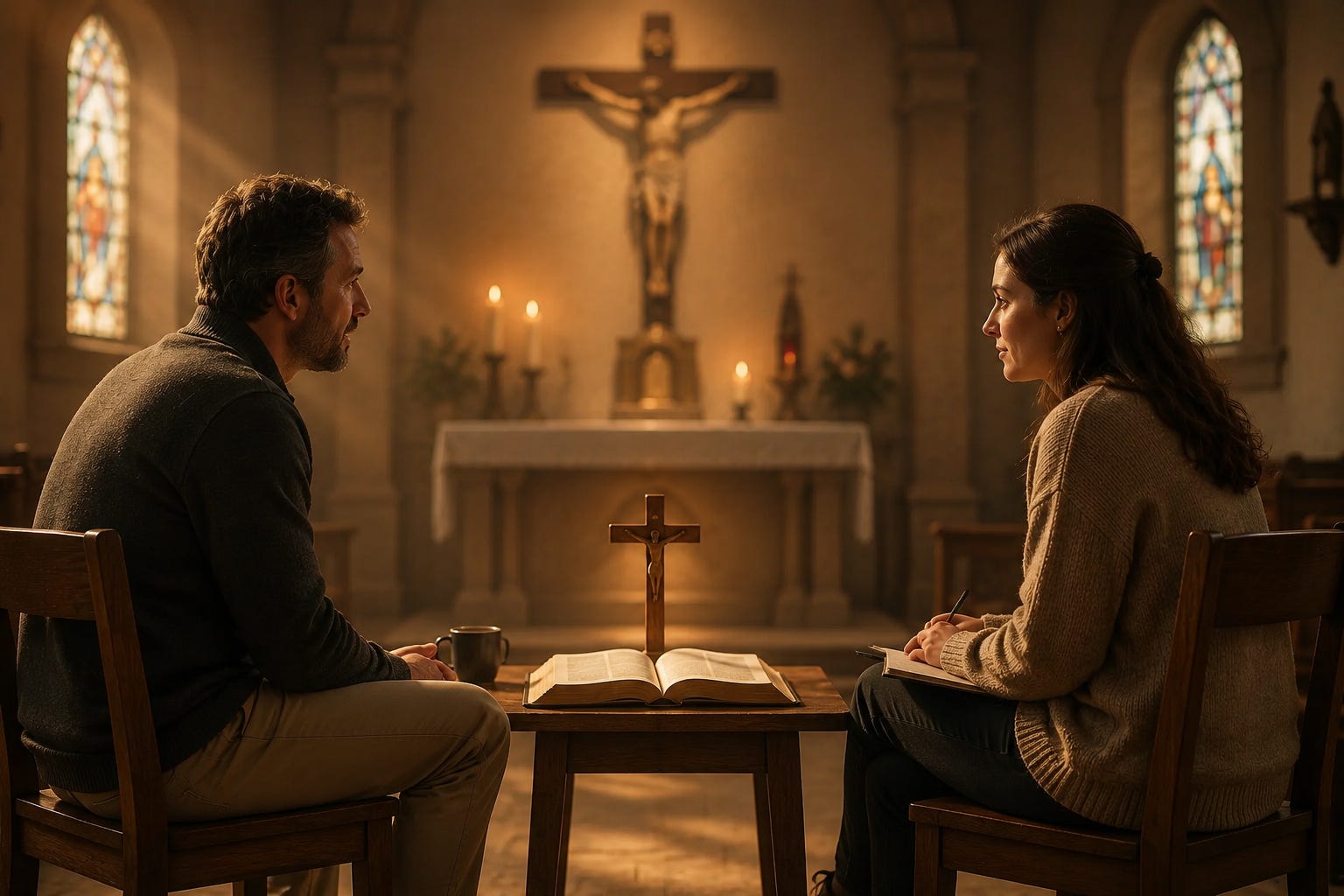
A friend tells you spiritual direction changed her life. Another warns you it is like cheap (and bad) therapy. Someone you respect is certain it is just the New Age in Christian clothes. And then a priest you trust tells you it is one of the oldest practices in the Church.
So which is it?
Both the enthusiasts and the critics are often partly right. The enthusiasts are right that something real, Christian and special happens in spiritual direction. The critics are also right that a great deal passes under the term and has very little to do with Christ. Both can be true at once. So what follows is an attempt to help tell them apart.
I understand the suspicion. I share some of it.
Over the years, I have heard reports about spiritual direction. “I spent an hour talking about myself.” “My director never once mentioned Jesus.” “It felt like therapy with a candle.” “My director talked about themselves for most of the time” “It sounded spiritual, but I’m not sure what about.”
If that is what spiritual direction is, they are right to walk away from it.
But….
You can misuse anything.
You can misuse preaching. You can misuse the Bible. You can misuse worship, prayer, the sacraments, mission and, as we know all too well, social justice. People have done real harm with every one of these things. We don’t conclude that mission, worship, prayer, justice, etc. are all invalid because of the misuse of those.
The misuse of a thing does not define the thing per se. It exposes what happens when its centre and true north have become lost. Spiritual direction is no different. To judge it by its distortions is to judge it by the exact moment it stopped being true to itself.
So the real question is not whether spiritual direction can go wrong. Of course it can. The question is what it is when it goes right and is right in and of itself.
Why it drifts

The reason so much of it drifts is not a failure of technique. It is due to the water we swim in.
We live, as Charles Taylor has shown, in an age of expressive individualism, where the self is something we author rather than receive. We live, as Philip Rieff saw, in a therapeutic culture, where the aim of the inner life is no longer holiness but feeling good. Our attention is harvested and sold. Our imaginations, desires and passions are captured before we have chosen anything. And the deforming result is a God remade in the image of our own therapeutic needs. A God who affirms. A God who soothes. A God who exists, conveniently, to help us become more fully ourselves, even when we have no idea who we are.
Drop spiritual direction into this cultural water, and it will absorb and dissolve it. This drift is not a plan. It is a kind of gravity well in which the self moves to the centre of everything, and everything begins to orbit it. Including spiritual direction.
Here is the hinge of the whole matter.
Every spirituality has a centre. Tell me what stands at the centre, and I can tell you, with some confidence, where the whole thing is going.
Self            →   therapy
Authenticity    →   self-expression
Consciousness   →   a generic mysticism
Christ          →   Christian formation
Put the self at the centre and spiritual direction becomes therapy. Put authenticity at the centre, and it becomes the cultivation of self-expression. Put consciousness or “the sacred” in general at the centre, and you get a generic mysticism that could belong to anyone or to no one.
Put Christ at the centre, the living Christ, and only then is it Christian formation. Not because of everything that happens within spiritual direction, but because of the One to whom it is ordered.
What makes anything Christian?
Someone often pushes back here and rightly so. Who decides what Christian is? Who are you to decide what is and isn’t Christian?
First, it is true that anyone can call anything Christian. The word is not trademarked. People attach it to practices, politics and products that would have baffled the apostles.
But, second, Christians have never accepted that the name Christian settles the matter of being Christian. From the beginning the Church drew boundaries. Paul confronted a different gospel and called it no gospel at all. John warned of spirits that would not confess Christ come in the flesh. The early church councils met to debate and discern what was Christian. The creeds were written.
The emergence of the creeds was long, costly, intellectually demanding, spiritually discerning, and anything but obvious. Christians didn’t wake up one morning and agree on precise formulations about Christ and the Trinity. They spent nearly four centuries wrestling with Scripture, worship, philosophy, language, persecution, and competing interpretations before arriving at the creedal consensus. That consensus emerged from a shared experience over time of Christ as their focus for life and death, and from asking a question beneath all their questions.
Who is Christ?
And then, in light of that, what does it mean to be a Christian, one who believes in and follows Christ?
So, then third, when I say spiritual direction must be Christ-centred, I am not inventing a definition of Christianity to suit myself. I am receiving one. I am using the same Christ that Scripture proclaims, that the creeds confess, that the Church has worshipped for two thousand years. I am not the author of this standard. I am its heir.
Not Christ as a warm idea. Not Christ as my inner wisdom. Not Christ as the most enlightened teacher in a long line of teachers. Not Christ as my therapist. Not Christ as my supreme affirmation. Not Christ that I have adjusted to fit my personal version of him.
But this Christ.
The eternal Son, the Word who rested in the Father’s heart before time found its first morning. The One through whom all things came into being: the galaxies in their silent splendour, the seas in their restless depths, and every human soul breathed into being.
He entered the world that his love had called forth, clothed himself in our fragile humanity, embraced our suffering, was crucified beneath the weight of our brokenness, descended into our death, rose with the dawn of a new creation, ascended into glory, and now reigns in the eternal communion of the Father, the Son and the Holy Spirit.
He became what we are, that we might be drawn into the mystery of who he is and, through him, be welcomed into the eternal communion of love shared by the Father, the Son and the Holy Spirit.1
This changes everything.
When Christ is at the centre, spiritual direction becomes something far larger than a conversation about my feelings and sense of self. It becomes Trinitarian. It is the Son drawing me, by the Spirit, into the life of the Father.
The spiritual conversation matters deeply, but it is not the destination. It is our small participation in a far greater movement that began before the foundation of the world and will never end.
Christian spiritual direction is one believer helping another to notice, discern and respond to the living Christ who is already present and already at work.
Notice the order. The director does not generate the encounter. Christ is there first. Direction only helps a person see what grace is already doing and answer it. The real director in every session is the Holy Spirit. The human one is a friend who points and says, quietly, “Look.”
Which brings me to the thing I most want to say.
The problem with bad spiritual direction is not psychology. It is not emotion. It is not silence. It is not the imagination. Every one of these can serve Christ, and often does. The problem is subtler, and sadder, than any of them.
The problem is that Christ quietly leaves the room.
No one announces it. No one decides it. The conversations stay warm, the insights keep arriving, the candle still burns. Experiences are still generated. But somewhere along the way the Christ stops being the subject, the centre and the goal. And the self slides into the space and place that he leaves.
Whenever spiritual direction ceases to be ordered towards encounter with the living Christ, towards communion with the Father through the Son in the Holy Spirit, it has suffered a christological heart failure. It may retain all outward signs of health, yet it has lost the very life it exists to share.
Five Questions Worth Asking
If you are wondering whether the direction you are receiving, or offering, is Christian, you do not need a checklist. You need the questions the Church has always asked.
Who is at the centre?
Which Christ am I meeting?
Is Scripture shaping the encounter, or only my feelings about it?
What is this ordered towards? My self-understanding, or my surrender.
Who am I becoming? More fascinated with myself, or more in love with him.
And then one last question, the one that tells you almost everything.
When I leave this conversation, whose presence has become more real to me?
If the answer is my own, something has gone wrong, however pleasant it felt.
If the answer is His, you have been in Christian spiritual direction, whatever else was or was not said, or however expertly or inexpertly it was made.
Christian spiritual direction does not exist to make us experts on ourselves. It exists to make us friends of Jesus Christ. To know him. To love him. To follow him. To be changed by him, and through him to be drawn into the life of the Father by the Holy Spirit.
That has always been the Christian vision.
It still is.
This echoes the classic patristic understanding of salvation as participation in the life of God. See Athanasius of Alexandria, On the Incarnation 54.3 (“For He was made man that we might be made God”), and Irenaeus of Lyons, Against Heresies III.19.1, where the incarnation is understood as Christ becoming what we are in order to restore humanity to communion with God.
I agree with much of your critique but does Christ ever really leave the room? Or do we stop noticing?
Thanks, well said.
I also firsthand experienced the annoyance of people when I refused to provide counseling (or spiritual direction), and instead offered to go with them to the best Counsellor (the Holy Spirit), so they can converse directly.
But in reality, sometimes what is needed would be totally irresponsible for a human to advise ...
... like telling Rahab to stay in her house (which was in the wall of Jericho) on that fateful day when the wall collapsed.
Sometimes only God can say what needs to be said.
So I believe my main aim in giving "spiritual direction" is to get the individual to converse with God about what they came to me for.
It's like the old story ...
... giving a starving person a fishing rod and show them how to fish instead of just one fish to eat.