


This is the second of seven pieces on why evangelicals are turning to Ignatian prayer. Part one, "Why Evangelicals Are Praying Like Jesuits", is here.
The word “Jesuit” began as an insult.
It was a derogatory term for a growing group seen as obsessed with Jesus and always talking about him. In the 1540s, a Jesuit was someone who used the name of Jesus too freely and frequently.1 Ignatius never used the sobriquet himself, but his followers did. They took what was meant as an insult and wore it gladly.
So the first complaint anyone made about the Jesuits was that they would not stop talking about Jesus. Jesus was their magnificent obsession.
I recognise this, because He is mine too. And instinctively, he is for all Evangelicals.
When I was turning seventeen, I walked into a school hall for an evening worship service with an Evangelical church community. Before I left, I had prayed with someone who introduced me to Jesus. When I woke the next morning, Jesus was my first thought. The faith I had received that night had one person at its centre. Christ was now my magnificent obsession, for life, meaning, and purpose.
There is something deeply Evangelical about this instinct, this reflex to love, know, follow and serve Jesus. To be obsessed with him. Evangelicals have a profound instinct for life in Christ. Yet so often that instinct is sustained through proximity to others: worship, teaching, Christian friendships and the shared intensity of faith. These are good and necessary things, but they can become substitutes for intimacy with Christ himself. We remain downstairs in the party, in the lower room, caught up in the energy of being together, while Jesus waits for us in the upper room.
We can know a great deal about Jesus and yet spend remarkably little time with him.
Our inner lives, our private worlds, become colonised by almost everything except Christ. So when we encounter the Jesuits and Ignatian prayer, something feels like coming home. Here are people every bit as obsessed with Jesus as we ever hoped to be, but who have learned how to be alone with him. With Scripture open, they invite us upstairs, away from the noise and activity, into the intimacy of an encounter with Christ that we have long glimpsed, desired and struggled to find.
Perhaps what we discover is not a different love for Jesus, but a way to finally enter more fully into the love we have always professed.
Heart Failure: When Jesus becomes a means to an end
We can speak the name of Jesus and yet lose Jesus himself.
For some, he has become little more than an example, a good man whose literal resurrection is no longer essential, a figure enlisted in the service of a cause or ideology we have been consumed by. Sometimes this displacement is easy to recognise. The language, symbols, and flags of a particular ideology find their way into worship, repeated so often that they become a liturgy of their own. The cause becomes the magnificent obsession, and slowly, almost imperceptibly, Jesus is displaced by the very things we claim to pursue in his name, a wrap-around for the real cause in our lives.
It is often easier to recognise these Christological displacements in others than in ourselves. The Evangelical version can be harder to see, precisely because the name of Jesus remains everywhere. We speak of him, sing about him, preach about him and invoke his presence. Yet even here, Jesus can become a smokescreen for a faith increasingly organised around ourselves, our needs, our experiences, and our concerns. We want Jesus to make us feel better, give us what we need, confirm what we believe and reassure us that we are right. Without quite noticing, we can turn a life centred on Christ into one centred on what Christ can do for us.
On any given Sunday, we might sing about Jesus for twenty minutes and listen to someone speak about him for another forty. We might ask him for all manner of things. And then we drive home. Yet it remains entirely possible that, amid all those words, songs, and prayers, we have spent barely a moment simply with him. Not asking for anything, not seeking an experience or an answer, not needing him to do something for us. Just being with Jesus, for his own sake, giving ourselves to him in love.
We can fill an entire service with the name of Jesus and still miss the intimacy of his presence.
And for many, when Christ becomes the means to our own ends, the result is what I call Christological heart failure.2 When an Evangelical faith increasingly invokes Jesus only to make us feel better, give us what we want, or rescue us in moments of crisis, our relationship with him can slowly become incidental to our lives. What begins as a disconnection from intimacy with Christ reaches its logical conclusion: abandoning the lower room with others for a faith in private spaces, us no longer at the centre of His life, but calling him on demand to be at the centre of ours. We become disconnected from both rooms of the Christian life: the shared life of faith downstairs in the lower room and the intimate encounter with Christ upstairs in the upper room.
Jesus warns of this condition himself. He told the most Bible-devoted people of his day that they searched the Scriptures for life, and that those Scriptures spoke of him, “yet you refuse to come to me to have life” (John 5:39-40).
The Jesuits: Inflamed with love
The Jesuits rightly earned their nickname. The Spiritual Exercises, the course of prayer Ignatius wrote, has four parts, which he called Weeks. Through the longest of them, a person begins every time of prayer by asking for the same thing:
interior knowledge of the Lord, Who for me has become man, that I may more love and follow Him. (Exx 104)
“Interior knowledge” is the goal and purpose. Ignatius wants us to know Jesus as we know a friend, from time spent together, and not only to know facts about him.
He also expects Jesus to turn up. He tells the person guiding someone in the Exercises to stand back and “allow the Creator to act immediately with the creature” (Exx 15). For Ignatius, a spiritual director helps bring others to Jesus, then steps away and comes back later to ask, "So what did you and he talk about?" How did you two get on?
Ignatius describes what such encounters with Christ can look like:
I call it consolation when some interior movement in the soul is caused, through which the soul comes to be inflamed with love of its Creator and Lord; and when it can in consequence love no created thing on the face of the earth in itself, but in the Creator of them all.
Likewise, when it sheds tears that move to love of its Lord, whether out of sorrow for one’s sins, or for the Passion of Christ our Lord, or because of other things directly connected with His service and praise.
Finally, I call consolation every increase of hope, faith and charity, and all interior joy which calls and attracts to heavenly things and to the salvation of one’s soul, quieting it and giving it peace in its Creator and Lord. Exx.3163
Evangelicals teach and preach that Jesus is alive. The Jesuits have a way of prayer based on that reality, and a way to enter into it.
The method is wonderfully simple and, in many ways, familiar to anyone raised with the Evangelical practice of a ‘quiet time’. Ignatius invites us to take a scene from the Gospels and read it slowly, perhaps twice, allowing the story to settle within us. Then, as he puts it, we begin with the “composition, seeing the place” (Spiritual Exercises, Exx.47).
We use our imagination to picture the setting: the road, the landscape, the faces, the people gathered around Jesus. Ignatius describes imagining the road from Nazareth to Bethlehem, its length and breadth, whether it crosses valleys or hills (Exx.112). We then enter the scene ourselves, not merely as spectators, but “as if I found myself present” (Exx.114).
We then notice the people, watch what Jesus does, listen to what he says, and attend to what stirs within us. Finally, we speak with him. Ignatius calls this a colloquy, a conversation conducted “as one friend speaks to another” (Exx.54). We bring him what is on our hearts, our questions, desires and concerns, and make room to listen. The purpose is not simply to learn more about Jesus, but to encounter him, to know him more intimately, love him more deeply and follow him more freely.
Here is what happened one time when I did.
At the Tomb: “Follow me?”

I had been praying the Spiritual Exercises every morning for nearly seven months, meeting with my spiritual director each week. I had finally reached the Fourth Week, the resurrection, where Ignatius invites us to ask for the grace “to rejoice and be glad intensely” (Exx 221).
But I couldn’t.
I was immersed in Mark 16, where the women make their way to the tomb, wondering, “Who will roll the stone away?” Their question had become my own. The losses of COVID, vocationally and emotionally, had taken their toll. So much of the life I had known seemed to have fallen away, and beneath it all was a fear I could barely name: what if I never recovered?
So, each morning in prayer, I found myself sitting outside the tomb. The stone remained firmly in place. Nothing moved. And I could not move on. What should have been a passage into resurrection joy became, for me, the longest Holy Saturday. I stayed there for six weeks, unable to reach the resurrection, yet unwilling to leave.
And it was there, outside a tomb I could neither open nor move away from, that Jesus came to me.
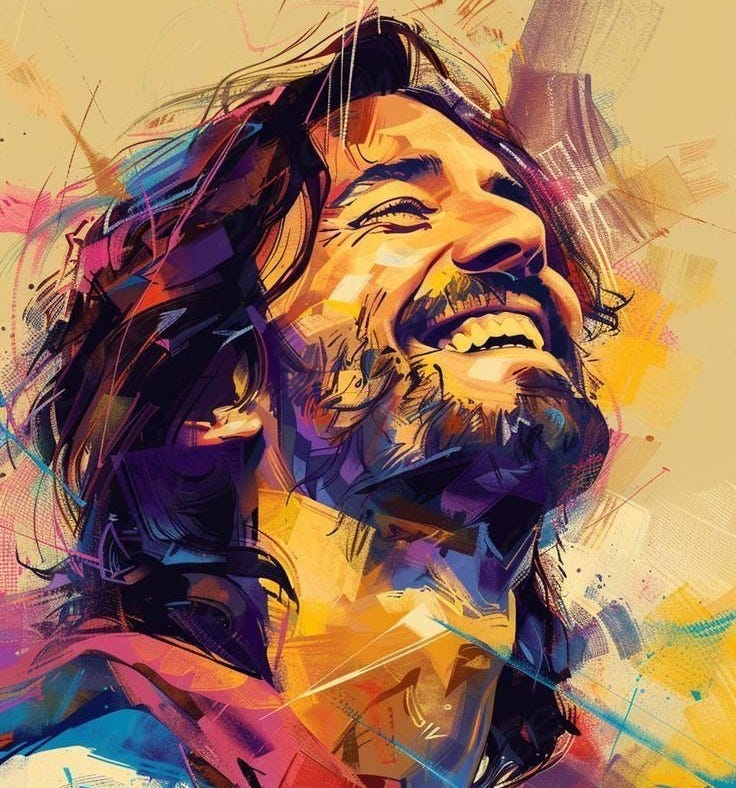
Finally, one morning, as I sat there in prayer, I saw the stone begin to roll away in my mind's eye. Light poured from the darkness, and there stood Jesus. Risen. Alive. His face was filled with the most enormous smile.
He looked straight at me.
“Follow me?”
His head tilted slightly to one side, grinning as he winked at me, asking the question as though he already knew my answer.
And something in me gave way. The losses I had carried, the fear that I might never recover, the chains that had quietly bound me to all that had happened, began to lose their hold. I was overwhelmed, not by an explanation of my suffering or a promise that everything would be restored, but by the sheer reality of Jesus, risen and alive, standing before me.
Here, with him, I was his, and he was mine. And freedom came.
My answer was yes. It had always been yes.
Then he turned towards the world, beckoned me to follow, and with that same wonderful grin said,
“Let’s go then!”
Was That Real? No, and yes
Anyone watching my prayer that morning would have seen very little. Just a man sitting quietly in a chair, as I had done for months, sometimes with tears running down his face. Yet something profound was taking place within me.
I know some readers will be suspicious of this, and there are good reasons to be cautious. The imagination can deceive us. It can give shape to our fears, fulfil our deepest wishes and persuade us that what we have imagined must be God speaking. That is a serious objection, and one I want to address properly in the next piece in this series. Ignatius himself was also cautious of how we can become captive to flights of fancy and imagination.
Yet something here is curious for those of us formed in Evangelical faith. We have never been particularly afraid of emotion or spiritual experience. We sing, we weep, we speak of hearing God’s voice, and we pray for one another using pictures and impressions that we believe may come from the Spirit. What we have often been less comfortable with is deliberately engaging our imagination in prayer, taking a passage of Scripture and allowing ourselves to enter the story, alone with Jesus.
And perhaps there is an irony here. While we have been cautious about allowing the imagination into our prayer, we have often left our inner lives wide open to everything else. Our fears, anxieties, ambitions, and desires have shaped our imaginations all along. The question is not whether we use our imagination, but what forms it, what occupies it, and how we discern what happens within it.
The foundation of this Ignatian way of prayer is not the power of imagination, but the reality of the resurrection. Jesus is risen. He promised to send the Spirit and told his disciples that, after a little while, they would see him again (John 16:7, 16). As George Aschenbrenner puts it, Ignatian prayer opens us to meeting “the risen Jesus, personally present right now in the Spirit”.4
This is what makes all the difference. We are not using our imagination to bring a dead Jesus back to life, or merely recalling someone who once lived. Through Scripture and prayer, we are opening ourselves to the presence of the One who is already alive and present to us.
We are not visiting the dead. We are being met by the living.
So I End Where I Began
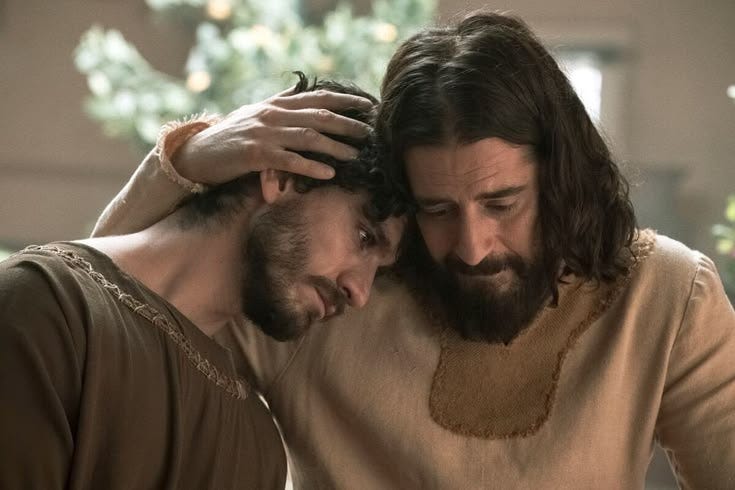
The Jesuits were once mocked for talking about Jesus too much. But their obsession with him was never the problem, any more than ours has been. The question is what we do with that longing, and where we allow it to take us. Ignatius offers us a way of moving beyond songs, podcasts and sermons, our conversations and convictions about Jesus, into the intimacy of actually being with Him.
After making the Spiritual Exercises myself, I trained as an Ignatian spiritual director. I wanted to accompany others through the Exercises, helping them discover for themselves the Jesus they had always longed to know more deeply and love more fully.
During my training, I gathered a small library of books on Ignatian spirituality, many written by Jesuit priests. And as I read them, something struck me. Five hundred years after Ignatius, that same magnificent obsession was still alive and well. These were not men writing about Jesus from a distance, offering abstract theological reflections or second-hand accounts of faith. Their words carried the unmistakable marks of lives spent in prayer, sustained encounters with Christ, and a deep, passionate love for him.
I recognised something of my own longing in their writing. Here were people who had spent their lives pursuing the very thing I had been searching for: not simply a greater understanding of Jesus, but a deeper friendship with him. And they had discovered something I was only beginning to learn. There is no end to knowing and loving the risen Christ. Nothing is more Evangelical than that.
Try it this week. Take Mark 10:46-52, blind Bartimaeus at the roadside. Read it slowly, twice. See the road out of Jericho, the dust, the crowd. Take your place there. Hear him shout, and hear the crowd tell him to be quiet. Then let Jesus stop and ask you what he asked him: “What do you want me to do for you?” Answer him honestly. Stay a while. Afterwards, write down what happened, and tell someone you trust.
Praying Like Jesuits: the series
The Magnificent Obsession (this piece)
A Relationship of the Heart (coming next)
Forgiven but Unformed (coming)
Not Straight to Sunday (coming)
You Become What You Pray (coming)
Contemplatives in Action (coming)
"Society of Jesus", Catholic Encyclopedia, https://www.catholic.com/encyclopedia/Society-of-Jesus, which dates the reproach to 1544-52 and notes that Ignatius never used the term; and "Jesuit", Jesuits.org glossary, https://www.jesuits.org/fr/glossary/jesuit/.
See my "Progressives, Nationalists, and the Christological Heart Failure of the Church", SpEx, 16 September 2025, https://www.spex.so/p/progressives-nationalists-and-the.
https://scepterpublishers.org/blogs/scepter-blog-corner/14-rules-for-the-discernment-of-spirits-by-st-ignatius-of-loyola
Aschenbrenner, Stretched for Greater Glory, p. 80.
Insightful.
As I often say, Evangelicals talk a lot about a personal relationship with Jesus, but I often wonder if it is mostly a slogan and not a lived reality. It's ironic that praying the Ignatian Exercises is the best way that I know of to develop a personal relationship with Jesus.