



In Part 1, I suggested that a crisis of identity lies at the root of all the crises of our age. And that this may be grounded in something even deeper: a crisis about reality itself.
You may have felt this yourself. You find yourself in conversation with someone you respect. Someone thoughtful, intelligent, well-informed. You’re both looking at the same events, the same headlines, the same facts. And yet, something doesn’t quite connect. We look not at faraway places, but at our own friends and family, and wonder why it seems that we no longer live in the same reality. Because in many ways, we don’t.
You can hear it everywhere now—in interviews, in news panel discussions, and in social media posts. Someone speaks with confidence, sometimes fluently. Their language is polished, morally charged, and full of the right key phrases. And yet, as you listen, something begins to slip. Their words circle around and around as their ideas fold back on themselves. Assertions replace arguments. Familiar phrases stand in for explanation. And there is no working out.
And you find yourself wondering instinctively:
What planet are they on?
It is not that they lack intelligence. Often the opposite. These can be thoughtful, articulate people. But their language is doing something more than describing reality. It is signalling belonging. It is expressing identity. It is locating the person speaking within a moral landscape.
Dialogue, conversation, and debate have collapsed. We are no longer seeking the truth, but signalling where we stand and defending it. Language has become coded, compressed, and self-sealing: claims are assumed, restated, and reinforced rather than tested. Circular reasoning gives the lie of coherence, feels safe, and is so very morally right. But this way of thinking and speaking never opens to testing of its claimed reality or to openness to others.
And often it seems most arguments have now collapsed into this infuriating summary assertion and claim:
It is, because I say it is—and because it is, it is.
What you’re hearing is closed-loop thinking. The claim proves itself, the speaker backs it up, and nothing outside it is allowed to test whether it’s actually true.
All reasoning closes in on itself: it is true because I say it, and I say it because it feels true. Allowing little room for a reality beyond, or for anyone to question or reshape it.
This closed-reasoning loop frequently manifests in statements like this:
I represent the community because I live here; I know what they want because I am the one representing them.
Trans identities are valid because they are lived experiences, and lived experiences are valid because they are how people identify.
God exists because the Bible says God exists—and, since God wrote the Bible, it must be true.
On my leadership website, I recently wrote about how to recognise these ideological patterns that are likely to suck you in, and about more effective ways to respond to them. But no matter how much you try to present any good logical reasoning to someone using arguments like these, the other person often doubles down, perceiving and treating your response to them as a threat to their safety, social status, and self-worth.
Which is why it can feel so disorienting. You are not just disagreeing with someone’s conclusions; you are disagreeing with their reality. What is real is the domain of ontology. When you push back on a specific argument, you are attacking a branch of someone’s argument. When you diagnose and address someone’s reality, you are going to the root of their being.
Understanding someone’s ontology—their most fundamental “map” of what actually exists for them, is key, because it is the operating system that runs their being. If you only argue about what you see as facts, you are essentially trying to fix a system bug while the user is running an entirely different Operating System (their ontology) that is incompatible with yours.
Ontological Questions

When you identify someone’s ontology, you stop seeing “stupid” arguments and start seeing how people have internally consistent ones for them that are based on a different reality. The most powerful reason to know an ontology is that it allows you to use the person’s own rules with them. This is often the only way to get traction with someone trapped in a closed-loop ideology.
You can stop arguing your reality and instead try to show how their reality is fragile. This can sometimes bypass their “identity shield” because it looks like you are helping them refine their own view rather than attacking it.
Ontological questions are like MRIs of the soul. They reveal the deepest reality of their beliefs. You can try to show that their identity cannot support the force of their own argument and break their closed loops. For example, try asking:
“What is the most ‘real’ thing to you?”
“Can something be true even if nobody believes it?”
“If every human being disappeared tomorrow, would [the concept we are debating, e.g., gender, justice, or race] still exist in the world, or would it vanish with us?”
“Is a person’s success (or failure) primarily the result of the choices they make, or the result of the ‘opportunities’ the system put them in before they were born?”
“Is it possible for two groups to have a relationship that isn’t defined by one having power over the other?”
Applying this to the claim that “trans women are women” - because it is probably one of the most extant examples of competing ontologies - we might ask:
“Is ‘woman’ a biological fact, a social role, or an internal feeling?” (Determines a person’s source of truth)
“Can a person be a trans woman if they are alone on a desert island with no one to see them?” (Determines if they believe it’s a Social or Internal reality.)
“What is the specific ‘thing’ a person is identifying with when they say they are a woman?” (Forces them to break the loop and provide a definition.)
But as we have likely already seen, when someone whose identity is deeply tied to a specific ontological framework is confronted with a “logical wedge” question, they cannot answer (a logical wedge is a simple idea or question that gets into someone’s argument and starts to break it apart by showing something doesn’t quite make sense). And they don’t just experience a “brain teaser.” They experience Ontological Shock and trauma.
Ontological Meltdown
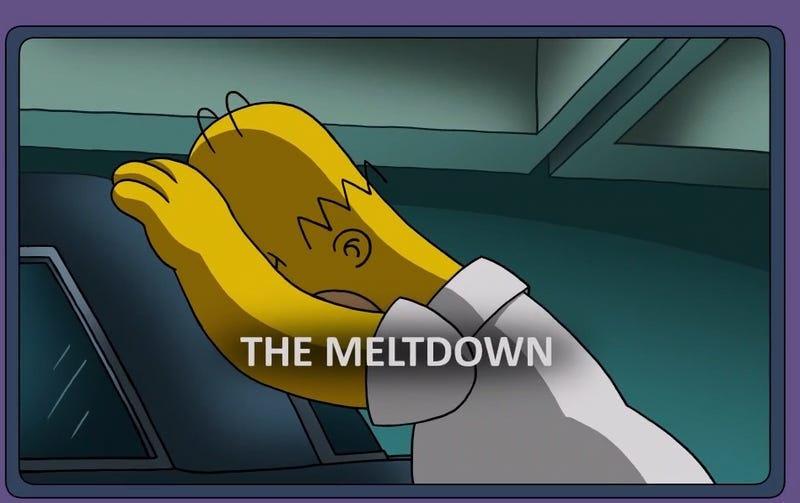
Psychologically, the transition from a calm debate to screaming and emotional volatility is a well-documented defence mechanism, now writ large in our daily lives online. People trapped in ideological closed loops literally cannot see them. Their ontology acts as a “filter” on their sense of self and reality.
Defence mechanisms kick in, for instance, with the “no debate” tactic. The move is often presented as a strength, but it is usually the opposite. When someone declares a subject as “not up for debate,” it’s rarely because their position is beyond challenge. More often, it reveals something deeper: their account of reality is too fragile to withstand any scrutiny.
It’s not confidence, but rather a display of ontological fragility and brittleness.
For example, when biological males who identify as women use intimidation or violent threats to shut down women’s gatherings, it reveals more than disagreement—it exposes an ontological fracture, where patterns of dominance and misogyny betray the very identity being claimed and of men still behaving like men.
If something is real, it does not need everyone to agree with it to exist. Gravity still works if you deny it, and biology does not change because we vote on it. But when a claim like “trans women are women” is treated not as something open to discussion, but as something everyone must believe, it reveals that something else is going on.
It is the trying to close a gap between an internal sense of self and an external reality that does not fully confirm it. Because that gap remains, the claim requires constant agreement to hold it together. It cannot simply be tolerated; it must be believed, fully and without question.
Ontological Harm
This is why disagreement is often not treated as disagreement. It is treated as harm. Even someone saying, “I don’t think that’s true,” can feel akin to a crack in the whole structure of someone’s existence.
So the pressure increases—not just to be kind, but to agree; not just to agree, but to affirm; and not just to affirm, but to declare that their reality is reality. At that point, it stops being about truth and becomes about enforcement. And that is the key signal to notice. If something needs everyone to believe it to be real, it is likely not grounded in reality in the first place. It is a fragile ontology.
Any screaming and shouting is rarely about you; they are a desperate attempt to re-stabilise a collapsing reality. If the “loop” is the only thing holding someone’s identity together, then logic isn’t a tool—it becomes a wrecking ball. And when this occurs, the best thing to do is not fight back, but exit the interaction kindly and carefully.
“I can see this is a very personal and emotional topic for you, and I don’t want to cause you distress. It seems we have a fundamental disagreement on the ‘starting point’ of what makes something real. Let’s talk about something else.”
Ontological Deconstruction

With all of this, we can begin to see what is really going on in our world. The ontological captivity and the projection of identity are at play. It gives us a way of asking better questions, questions that go to the heart of fragile accounts of reality. And as we have seen, doing so will often trigger defensive, even hostile responses.
So why bother?
First, to keep our sanity—to recognise that what we instinctively sense as faulty really is, and to understand why. But also to ensure we do not become captive to these same patterns ourselves, and to protect those around us who are at risk of being shaped or harmed by them.
Before we move on to better, more grounded accounts of identity and faith, we need to pause and look at ourselves. Christians have not been immune to distorted ontologies. At times, we have embodied them in ways that have harmed both ourselves and others. Often, this is why many Christians abandon one fragile ontology only to take up another—either to replace their faith, or to relocate it into something ontologically adjacent (Climate/DEI/Trans/Immigration, etc.)—largely unaware that their new beliefs and identity are protected by the same kind of fundamentalist defences they thought they had left behind.
If we can name that honestly, we may be better able to discern not only the faulty visions of reality now competing for our allegiance, but also the forms of Christianity we must learn to resist, too.
Christian Deconstruction
Fragile ontologies don’t collapse all at once. They hold together until they can’t.
For a time, people can live inside a closed system of belief, managing the gaps between what they are told and what they can see and experience. A Christian can ignore inconsistencies, explain them away, or double down with a ‘just have more faith’ mantra for a while. But there is always a limit.
The breaking point comes when the strain of denying reality outweighs the cost of facing it. When the language that once held beliefs together becomes thought-terminating cliches and self-referential platitudes designed to prevent real consideration of any doubts or questions. Such as:
You’re just going through a season of doubt.
You’re stuck in your head; you need to get into your heart.
You’re just looking for reasons not to believe so you can live how you want (sin).
You’re making it too complicated; just have faith.
Such phrases begin to feel like a way to shut down questions rather than any real answer. At that point, the cloed-loop starts to crack. And often, this is not merely a shift in ideas, but a major ontological shock. The whole structure of faith gives way because it was never anchored deeply in a better Christian ontology and reality in the first place. And many don’t just lose a version of faith—they lose faith itself. And the collapse can be very sudden.
That is the danger of all fragile ontologies. They cannot absorb reality. So when reality finally breaks through, everything built on them comes down with it.
Given not Created
So how do we begin to grow into a deeper, more grounded sense of what is real—something that can actually carry the burden of our lives. Not only our hopes and dreams, but also our losses, our disappointments, and the parts of our story we would rather avoid?
This is where many people now find themselves. The questions are no longer only about the world around us; they are now about ourselves. Who am I, really? And how do I know?
What would it look like to receive an identity in Christ that is not thin or virtue performed, but something we can genuinely live from? Something rooted and held together across both the material realities of our lives and the more profound spiritual ones, too? What would it mean to have an identity that does not need to be constantly asserted or defended, but can hold us even when everything around us feels unsure?
In this article (part 2), we saw how the collapse of shared reality has made identity increasingly unstable. When we no longer agree on what is real, it becomes much harder to receive who we are. And so, often without realising it, we begin to construct and self-create. We assemble identity from within; we express it, defend it, and refine it. Over time, identity becomes a project—something we are responsible for building and maintaining.
But what if identity was never meant to be something we build? What if it was always meant to be something we receive?
This is where the Christian vision becomes both deeply challenging and deeply hopeful. Christianity does not begin with the self; it begins with God. And from that starting point, identity is not something we create out of our own inner resources, but something given—something discovered through relationship, through participation, and through being drawn into a reality that is already holding us.
The question, then, is not simply “Who am I?” but, “Who am I if my life is received rather than constructed?” And what kind of understanding of reality makes that even possible?
Which is what I’ll explore next In Part 3 — Identity: Given or Invented?
I thought you might find this article from the world of cybersecurity interesting, as it also talks about how our ontologies matter so much. https://cptkj.substack.com/p/intro-to-reality-pentesting
This is like a breath of fresh air 🙏🏻