


I was abused as a child. My mother was the abuser. Both my parents died by suicide. I carry a genetic inheritance of depression and anxiety, not as a theoretical vulnerability, but as a daily feature of my interior life, my whole life.
I am not telling you this to establish credentials for suffering. I am telling you because what I want to say is only worth anything if you know I have actually lived it.
And this article is not about why any of this happened. Because most writing about suffering first reaches for that question, and I think it is often the wrong one. In my personal experience and as a pastor for over twenty-five years, the why rarely survives contact with actual grief, actual pain, actual abuse.
What people need is something to do with the suffering that is already there. But I need to name one answer before I go further, because it is so common and so damaging that leaving it unnamed would be a disservice.
The Answer That Does the Most Damage

It goes like this.
God directed this. He allowed it, planned it, shaped it, because he knew what good he would bring out of it. He needed to form you this way.
Sometimes this message arrives as a bible verse given to you. Sometimes, with a gentle pastoral arm around your shoulder. It is almost always offered with genuine love.
It is not the God of Scripture. It is abhorrent.
A God who instructs suffering into your life, who designs your abuse, your bereavement, your illness as instruments of some later purpose, is not the God I recognise from the Gospels or from the long tradition of the Church. He is not a cosmic engineer of cruelty who then asks you to be grateful.
I have watched people lose their faith trying to sustain that gratitude. I have watched others go quiet inside, concluding that a God who works like that is one they cannot love.
God does not direct suffering into your life so he can use you later. That is not a reason. That is not comfort. And it is not true. God may allow suffering for greater purposes, and he most definitely redeems and transforms us through it. As I have discovered. But he is not the author or the genesis of the abuse and lack I suffered.
Closer, But Not Enough
We live in a world that is profoundly broken, at structural, relational, and biological levels. The harm of other people’s sin lands in bodies and psyches that did not ask for it. The collective weight of human fallenness generates consequences distributed without fairness and without warning.
My mother’s choices, my parents’ despair, the particular chemical inheritance I carry. None of it was directed at me by God. It was the tragedy of a broken world, and the harm of sin I did not commit. And then so many times my own sin was leveraged and catalysed into more pain.
This understanding of fallenness restores the truth that suffering is not what God wants or intended. But it is not enough for the day I am actually living in. It explains the landscape. It does not tell me what to do with my body, mind and soul, while I am standing in it and hurting.
Christ Enters: The First Movement
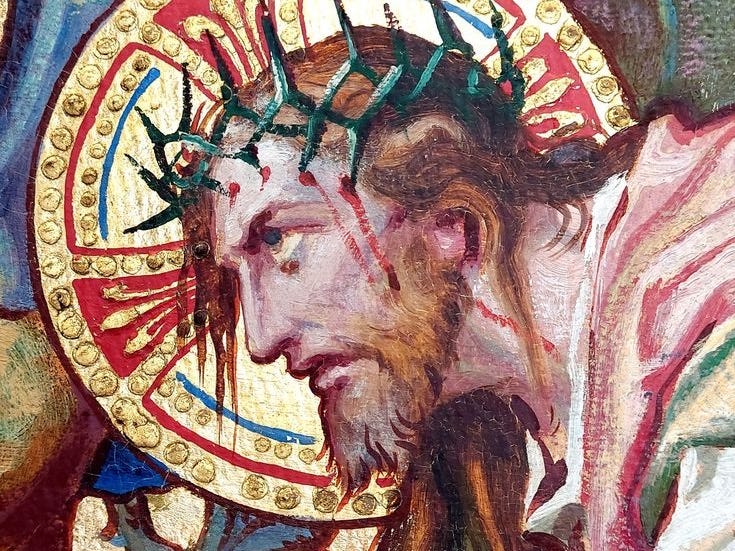
Here is where I want to go next. Not an explanation. But a way of participating.
Most Christians have some grasp of the first movement with Christ and suffering. Christ enters our suffering. The incarnation means exactly that. God in a body, God in the full range of human experience, including its most devastating corners. Good Friday is not a symbol. It is God taking suffering and death into himself from the inside. He knows grief from within. He is not remote from your pain. He is in it. I do not want to move past this too quickly, because for many people, it is the beginning of everything.
But the incarnation is not only about sympathy. The ancient word for what Christ does is recapitulation. He gathers up the whole of human life, every experience, every wound, every darkness, and carries it through death into resurrection. He does not redeem humanity from a distance. He enters it, lives it fully, and transforms it from within. The pattern he traces is the pattern we are invited to follow.
And here is where most of us stop.
We have been told that Christ did everything, and that there is nothing left for us except to receive the benefits. So we position ourselves at Easter. We take the resurrection and keep the cross at a comfortable distance. We ask Christ to carry what we will not touch ourselves. And in doing so, we miss the very route into the life we are seeking. Because the way into resurrection runs through Good Friday. It always has. It always will.
Christ did not abolish suffering. He recapitulated it. He took it into himself and carried it somewhere it could not go alone. And he invites us into the same movement. To pick up the cross and follow him into his life, his death, his rising. Not as a performance of piety. As the actual shape of Christian existence.
Most of us keep Christ safely on the resurrection side and wonder why we feel distant from him in our darkest moments. The answer is not that he is absent. The answer is that we have not yet followed him to where he is.
So there is a second movement. It is less travelled. It is, I think, among the most extraordinary things in the New Testament.
A Minority Report: The second movement
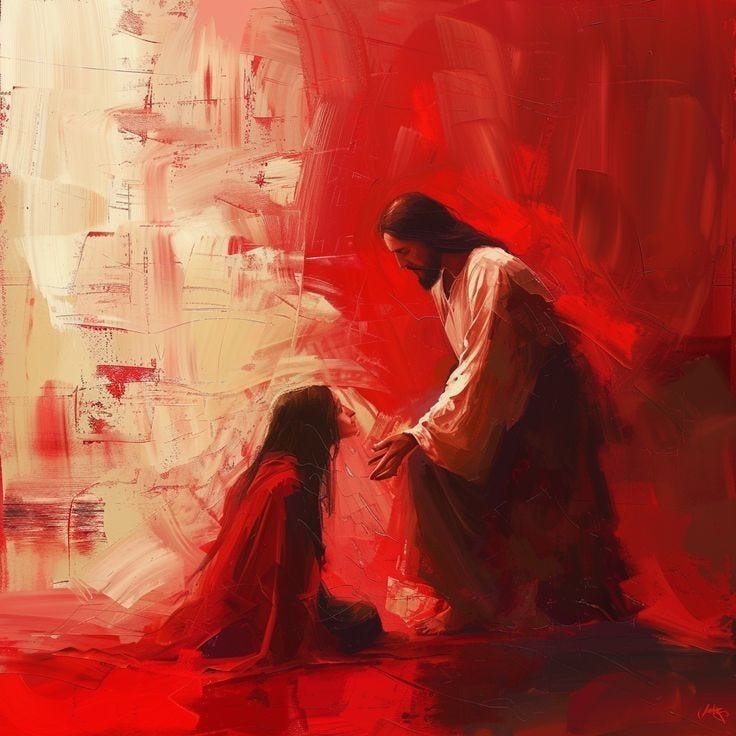
Paul writes to the church in Colossae that he rejoices in his sufferings, and that in his flesh he is filling up what is lacking in Christ’s afflictions. Theologians have wrestled with this phrase for centuries. What could possibly be lacking in Christ’s afflictions? The cross was not insufficient. That is not the answer.
The answer is that the body of Christ in the world is still living his life. The incarnation did not conclude at the Ascension. It continues in us, through us, as us. Caryll Houselander, the English mystic whose work I return to often, saw this with a clarity that still arrests me. What happened to Christ on earth is happening to him now in his members. His whole life is being lived now, through the whole body. Each of us carries a fragment. A moment. A particular experience.
She puts it this way:
Each of us can only live a fragment of Christ’s life at one time, perhaps one moment or one incident or one experience. But through our communion with one another in him, through our oneness because of his one life in us all, we make up what is lacking in one another and are whole.
Hidden in His Wounds
That word: fragment. Let’s press into this.
My suffering—the abuse, the grief, the depression—is a fragment of his life that I am carrying in my body, in this moment of history, in this particular nervous system. It is not outside him. It cannot be outside him, because I am in him. And because I am in him, what I carry, he carries. My suffering does not only go to him for comfort. It has become a dimension of his life.
Hidden in his wounds, as the old prayer says. My wounds are hidden there. And in that hiddenness, the suffering becomes more than something to survive. It becomes an act of worship.
This does not make what happened to me good. The abuse was wrong. The suicides were devastating. The depression is real and needs care. I am not spiritualising any of it. I am saying that suffering brought into participation with Christ is taken up into the largest possible life. Into the life of the one who has been through death and returned. Who is still interceding. Who is alive in the world today in his body.
You are his body. Your history is part of that body. Your past suffering, your present struggle. They are not residue from which you need to fully recover before you can be useful to God. They are, right now, fragments of his life being lived in you.
My anxiety can be taken to him, to kneel beside him in Gethsemane, and bear witness to his suffering and him to mine. To receive the grace that my anxiety in my life and in the world, bears something of him into the world too.
The Invitation
Most of us learn to manage our suffering from a safe distance. We position ourselves on the Easter side of things and ask Jesus to fix what Good Friday broke. We want the resurrection without the descent, the healing without the wound, the light without the long passage through darkness. And so we hold our pain at arm’s length, explaining it, spiritualising it, waiting for it to resolve into something more acceptable and easier to carry.
But your Good Fridays are not problems waiting to be solved. They are thresholds waiting to be entered.
When you bring your suffering to the cross, it does not disappear into Christ. It is gathered into him. And in being gathered, something astonishing becomes visible. What you have endured, the abuse, the loss, the long dark inheritance of grief and anxiety, ceases to be only yours. It becomes his. A fragment of his life, held in your particular body, history, and soul.
This is not mere poetry or wishful thinking. The body of Christ is real, and it is alive in the world today, and you are part of it. This means that when you take your suffering to him, you are not handing it over to be discarded. You are discovering what it always was. A presentation of the living Christ. His wounds carried in yours. His sorrow moving through your sorrow. His love making itself known at the exact coordinates of your pain.
There is a solemn delight in this when you begin to grasp it. Not the false joy that pretends the suffering was worth it, or sent for your benefit. The deep and ancient joy of discovering that nothing in your life, not even its darkest passage, has ever been outside him. That your wounds have been hidden in his all along. That what you thought was only damage is also, somehow, glory.
You are not being asked to perform this. You are being invited to receive it.
Bring your Good Friday to his. Not to make it meaningful in the abstract, but to discover it is already meaningful in the particular. In your body. In your history. In the life that only you have lived. Christ is not waiting for you on the other side of your suffering. He is in it. He has always been in it. And as you enter into him through it, you become, in the most literal sense, his presence in the world.
That is the privilege. Body, soul, mind, and spirit, not merely expressing him but presenting him. The real, resurrected, living Christ, made known today in you.
….also, just wanted to share that this is the first time I have ever really understood what and how it truly means that we are able to share and participate in the sufferings of Christ! Thank you again for sharing this post with us.
ahhhh. I am only recently beginning to be able to visualise being part of Jesus. I love the word fragment -
Sorrow is soft. suffering is sharp. companionship is essential on these, difficult, exhausting voyages. Thank you.